
TOPEKA — A Senate bill endorsed by the Kansas Secretary of State’s Office would end advanced voting by mail if a court strikes down state law requiring election officials to verify a voter’s signature.
The prospect of such a ruling is playing out in Shawnee County District Court, where voting rights groups argue the signature verification process is unequally applied from one county to another, leading to the disenfranchisement of lawful, qualified voters.
The Kansas Attorney General’s Office, which is tasked with defending the state law, relied on the artificial intelligence platform ChatGPT for assistance with at least one of its legal briefs in defense of that lawsuit.
Clay Barker, general counsel for the Secretary of State’s Office, told a Senate committee Monday that Senate Bill 394 would allow the Legislature to “lay down a line” that says signature verification is such an integral part of voting by mail that the two can’t be separated.
Don’t miss a beat … Click here to sign up for our email newsletters
Click here to learn more about our newsletters first
“It sets legislative intent to unambiguously establish with certainty and beyond dispute the signature verification is not severable because it’s intertwined with everything — the application, the ballot, you can’t even open the envelope until the signature is verified,” Barker said to the Senate Federal and State Affairs Committee.
Kansas has required a form of signature verification for mail ballots since 1995. Under state law, voters sign the mail ballot envelope, and local election officials have to verify that the signature on the envelope matches the one on the voter registration file. If there appears to be a discrepancy, the election office has to attempt to contact the voter, who could bring a photo ID to the election office to resolve the matter.
Barker said there were 300,000 mail ballots returned in 2022 and 2024, and just 224 were rejected because a signature posed a concern and the voter didn’t “come back and cure it.”

Legal wrangling
The League of Women Voters, Loud Light, Kansas Appleseed and the Lois Curtis Center challenged the signature verification law in a 2021 lawsuit that remains under litigation.
The Kansas Supreme Court in 2024 ruled the law was a valid attempt by the Legislature to determine whether someone is qualified to vote. But Justice Caleb Stegall noted in his opinion that the Legislature must comply with constitutional guarantees of equal protection and due process. He ordered the district court to look at whether the law was being uniformly applied and whether reasonable notice was being given to voters to fix problems with their signatures.
Melissa Stiehler, advocacy director of Loud Light, prepared opposition testimony to the proposed Senate bill but missed a deadline to file it for the Monday hearing. She said evidence in the court record showed that when three county election officers were asked to demonstrate their signature verification process, all three accepted forged signatures and two rejected valid ones.
One county election officer compared the process to “judging a pie-eating contest,” Stiehler said.
The court record also shows that Kansas voters sometimes get little notice that there is a problem with their signature. Sometimes, because of slow mail delivery, the notice arrives too late.
Additionally, Stiehler pointed out that a Nov. 14, 2025, filing by the Attorney General’s Office, which was signed by Wichita attorney Bradley Schlozman, twice used links produced by ChatGPT for supporting materials. One of the links pointed to a 2020 Kansas Reflector story for evidence of how many mail ballots were cast in Johnson County that year.
“If the Legislature is displeased with a court ruling because they feel it is unjust, it may be worth looking at why the law was so difficult to defend,” Stiehler said. “Is it an issue with the courts misinterpreting the law or could it be an issue with the state’s representation?”
Danedri Herbert, spokeswoman for the Attorney General’s Office, said the office prohibits the use of generative AI to create court documents. Within court filings, the office requires that the use of AI be disclosed, she said.
“Generative AI may be used for tasks short of content creation (such as editing, outlining, research assistance, or discovery review),” Herbert wrote in an email to Kansas Reflector.
She didn’t immediately respond to a follow-up question about whether the Nov. 14 filing complied with office policy.

‘Recipe for voter suppression’
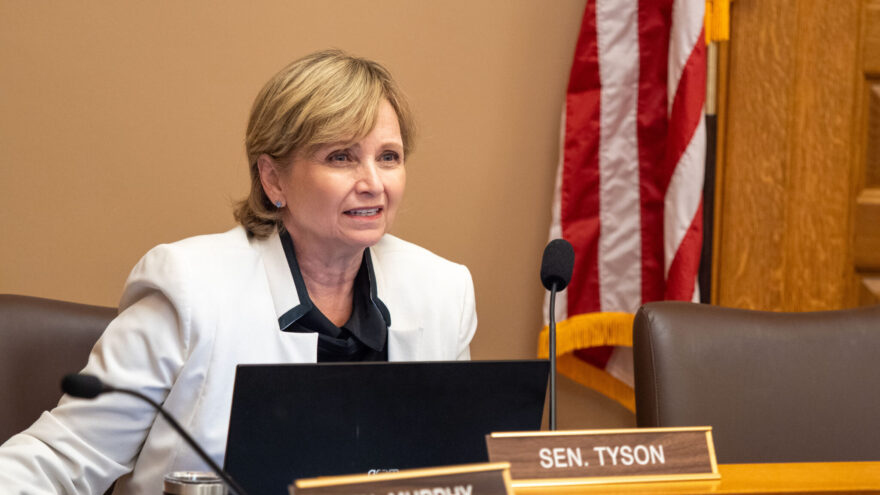
Logan DeMond, director of policy and research at the American Civil Liberties Union of Kansas, clashed with Sen. Caryn Tyson, R-Parker, over his assertion that signature verification laws discriminate against certain types of voters.
DeMond told the Senate committee that signature verification requirements discriminate against people with disabilities, transgender people, women who change their names when they get married or divorced, and voters overseas.
“Instead of making it easier for eligible citizens to vote, this is erecting a new barrier,” DeMond said. “Essentially, voters have challenged this process not because they want to cheat, but because it is unreliable, it is arbitrary and it is discriminatory, and that’s exactly why the courts step in.”
He said the bill was “a proxy” for ending mail-in voting altogether and “a retaliatory approach.”
“This forces voters to accept a flawed and discriminatory system or lose mail-in voting altogether, and it is a recipe for voter suppression,” DeMond said.
Tyson told him the bill was “common sense legislation.” She told him she found his remarks “offensive.”
“Who is discriminating?” Tyson said. “I know my county clerks would be completely offended by your comments. They are not discriminating against anyone. So who are you insinuating is discriminating?”
“I’m talking about the voters who are being attacked by the signature verification process,” DeMond said.
Kansas Reflector is part of States Newsroom, a network of news bureaus supported by grants and a coalition of donors as a 501c(3) public charity. Kansas Reflector maintains editorial independence. Contact Editor Sherman Smith for questions: [email protected]. Follow Kansas Reflector on Facebook and Twitter.
Don’t miss a beat — get the latest news from the Times delivered to your inbox:
Click here to learn more about our newsletters first
Latest state news:

Kansas legislators share frustration over surging waitlist for services to people with disabilities
Kansas legislators object to diversion of $24 million to disability services for frail older people and people with brain injuries that had been earmarked for benefit of Kansans with intellectual or developmental disabilities stuck for years on a bloated waiting list.