
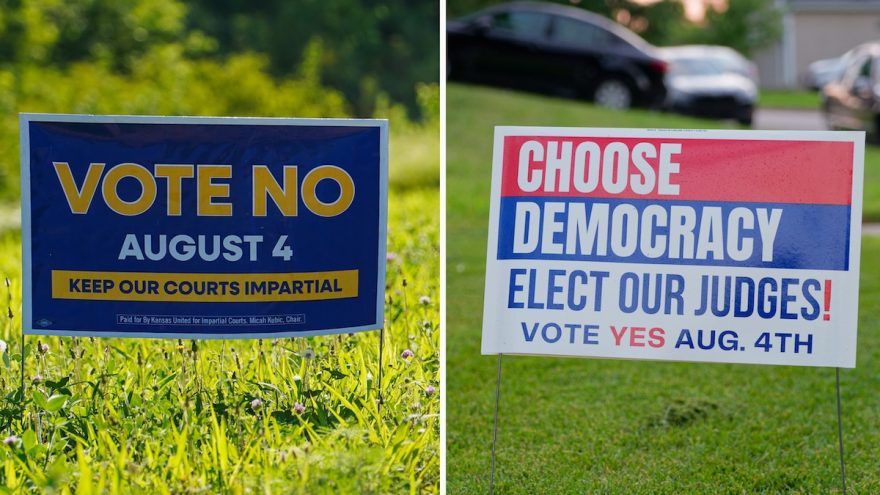
Advance voting is underway in Kansas, and folks are unfolding their paper ballots to find a lengthy excerpt of the state constitution on the back.
Driving around Lawrence, you’re likely to see whole streets populated with blue and yellow “vote no” signs, with fewer “vote yes” signs interspersed. The opposition has even taken up the motto of “Vote no, again,” referencing a 2022 ballot measure to restrict abortion care that the majority of Kansans shot down.
All Kansas voters — regardless of whether they are affiliated with a party or not — can cast a ballot in the Tuesday, Aug. 4 primary election because of the proposed amendment.
Here’s what you need to know about the history and projected future of the judiciary depending on whether a simple majority of Kansas voters — 50% plus one vote — vote “yes” or “no.”
This FAQ is informed by interviews with lawyers Amii Castle and Josh Ney, who each present one opinion on different sides of the issue.
Don’t miss a beat … Click here to sign up for our email newsletters
Click here to learn more about our newsletters first
Castle is a professor of practice in KU’s schools of law and business, as well as a lecturer in the university’s political science department. She practiced as a lawyer for 20 years and was a law clerk to three federal judges. She’s an at-large member of the Douglas County Democratic Party.
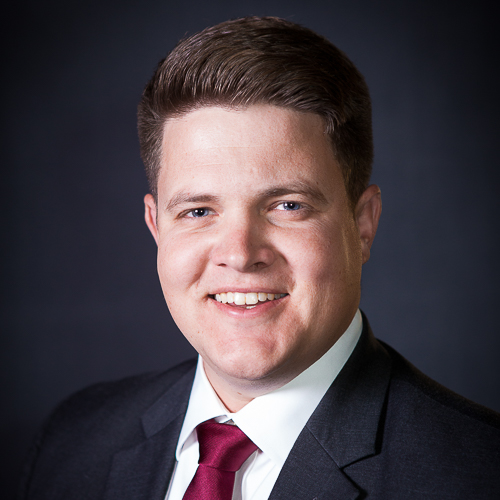
Ney serves on the Kansas’ 2nd District Judicial Nominating Commission and has been the Jefferson County attorney since 2017. He has also served on the Kansas Human Rights Commission and is a partner at KN Law Group, a private firm. Ney, a Republican, said he’s spent 17 years testifying against the current judicial selection process.
Jump to a question:
• What is the Kansas Supreme Court?
• What is the proposed constitutional amendment, and what would your vote mean?
• What isn’t in the language of the proposed constitutional amendment?
• Why did Kansas switch from elections to a nominating commission in the first place?
• How does the current nomination system work?
• What are some other arguments for the constitutional amendment?
• What are some other arguments against the constitutional amendment?
• What does this amendment have to do with hot-button issues, like abortion and public school funding?
• How and when can I cast my ballot?
What is the Kansas Supreme Court?
“The Supreme Court is the highest court in the state court system,” according to its webpage. “Its decisions set binding legal precedent that lower courts must follow.”
The bench is made of seven justices who, in addition to more run-of-the-mill cases, take on cases where they interpret the words of the Kansas Constitution. They make rulings on queer and transgender rights, school funding, healthcare autonomy, renewable energy, voting regulations and many other critical issues.
What is the proposed constitutional amendment, and what would your vote mean?
The amendment suggests a change to the way that Kansas Supreme Court Justices are appointed, moving from a nominating commission system to direct election. (More on the current nominating commission process below.)
Please support
The Lawrence Times!
Subscribe here.
Here’s the explanatory statement for the proposed amendment: “This amendment gives the voters the right to elect the justices of the Kansas supreme court. The justices shall serve terms of six years, with the elections of justice positions 1, 2 and 3 to occur in 2028, positions 4 and 5 to occur in 2030 and positions 6 and 7 to occur in 2032, and every six years thereafter. The rules applicable for such elections and the designation of position numbers shall be provided by law. Any vacancy on the court for an unexpired term shall be filled at an election as provided by law.”
Here’s the language of Article 3 of the Kansas constitution as it stands. Read the full text of the amendment at this link in English and Spanish.
A “no” vote is a rejection of the proposed amendment in favor of the current system for appointing Kansas Supreme Court justices.
A “yes” vote favors direct election of justices by Kansans.
What isn’t in the language of the proposed constitutional amendment?
The amendment takes out language that currently bars judges from making political contributions, holding an office in a political party or participating in political campaigns.
The amendment also outlines a schedule for elections, but no other details: Would they be partisan or nonpartisan? Who could run for a judicial seat and what are the requirements? Would elections be statewide or by geographic district?
“As someone involved in drafting exactly what needs to be constitutionalized versus what is left to the lawmaking process, it was very intentional to not over-constitutionalize issues that there needs to be significant public debate about over time,” Ney said.
The language, according to Ney, keeps voters focused on the core issue.
For Castle, the lack of specificity is scary.
“The problem is that we don’t know what the qualifications, if any, would look like,” she said. “… They haven’t told us what the requirements for running would even be, and so that’s scary. That is really scary given the types of cases these seven justices decide.”
Why did Kansas switch from elections to a nominating commission in the first place?
Kansans originally elected judges in partisan, statewide races until 1958, when the electorate voted to pass a constitutional amendment in response to the infamous “Triple Play” scandal.
In 1956, Kansas Gov. Fred Hall lost his bid for reelection shortly before William Smith, his friend and chief justice, resigned. Hall also resigned as governor shortly after, and his lieutenant governor, John McCuish, then appointed Hall to the Supreme Court.
The Triple Play was technically not illegal, but infuriated many Kansans.
The Legislature passed a constitutional amendment in 1957 to move toward a merit-based nomination system with panel screening. A strong majority of voters backed the amendment, which has guided Kansas judicial selections to this day.
How does the current nomination system work?
Kansas has a nominating commission: an independent body that consists of nine people who select three possible candidates to fill the spot of a justice who has died or retired.
Each of Kansas’ four congressional districts has one lawyer and one layperson, or non-lawyer, on the commission. Castle said lawyers are chosen by fellow attorneys in their district, and the governor selects the laypeople. The ninth person is a lawyer who chairs the commission, and all attorneys in the state have the opportunity to vote for that person.
Candidates must be at least 30 years old and have 10 years under their belt as a lawyer, practicing judge or full-time law professor. They complete an extensive application and submit a copy of their credit report from three credit-reporting agencies for the commission to review, per Castle.
As part of the application process, they list attorneys they’ve practiced with and against and judges they’ve appeared before, and the commission solicits feedback from those people.
Then, the commission hosts public interviews with the candidates. (Gov. Laura Kelly appointed a new judge to the Supreme Court on July 13 — see all of the public interviews from that process on YouTube here.)
Following interviews, commissioners send their top three candidates to the governor, who must make a selection within 60 days. Those candidates also undergo a Kansas Bureau of Investigation background check.
One year after a justice is appointed, they appear on every voting Kansans’ ballot to vote on whether they should or should not be retained. This is an opportunity for Kansans to remove a judge from the bench. After that first year, judges resurface on ballots every six years.

“I consistently refer to it as a merit-based system because of that vetting of the commissioners,” Castle said. “And if the amendment passes, the nominating commission completely goes away, so there’s no vetting.”
Ney said “merit” is nebulous and hasn’t been strictly defined. Without an objective standard, he said, what is or isn’t meritorious is up to the nominating commission.
“Lawyers are perhaps the worst group of people to be vetting potential Supreme Court justices because they have a unique self-interest that normal, ordinary laypersons don’t in making sure that they pick the person that ultimately is going to get on the Supreme Court,” Ney said.
Castle pushed back on the proponents’ concern that lawyers are in back rooms selecting Kansas judges, pointing to the four non-lawyers on the commission. Even without a direct election, Kansans still have a say through retention elections, she said.
“We, the people, actually do have a voice there on our ballots the first year after they’re appointed and every six years thereafter,” Castle said.
A Supreme Court justice has never been removed through a retention vote in Kansas. Castle sees this as a sign of the nominating commission’s efficacy; Ney thinks it’s because people are underinformed about judges’ bench decisions.
“As an attorney on Election Day, I get, on average, between 10 and 15 different people texting me asking me, ‘Do you know anything about these judges? How should I vote?’” Ney said.
Castle said she doesn’t think direct election will solve potential voter education issues.
“All we’re going to know is what they tell us in their stump speeches and what we can find on Google,” she said.
If resources like this are helpful to you, please support The Lawrence Times.
Click here to subscribe.
What are some other arguments for the constitutional amendment?
No system is perfect: Ney said there will be flaws to any possible appointment system. Even under the current nominating system, he said there has been public debate about the ethics of justices’ conduct.
For example, Justice Dan Biles had recused himself from a case but then rejoined it in 2024, causing Kansas Attorney General Kris Kobach and Secretary of State Scott Schwab to file a motion for clarity.
Giving the electorate more power aligns with Kansas’ populist history: “I think that Kansans are fully capable of picking their own government, and I don’t think we need an exception to democracy when it comes to all three branches,” Ney said.
He opposes allowing a trade group — in this case, lawyers — to have control over the judicial selection process.
“I think that any constitutional republic needs to derive its government ultimately from the people,” Ney said. “By constitutionalizing a special interest group of individuals in Kansas who chose to go to law school instead of become an engineer, or, say, a parent or a plumber or any other profession — that having a trade group in the constitution is not in keeping with what it means to be a democracy.”
The Triple Play wasn’t an election scandal: He questioned why a gubernatorial scandal — not an election scheme — led to the current nominating commission. He said the language on the ballot would prevent future Triple Plays.
Under the amendment, judges would have forced staggered terms: These terms, Ney said, would keep judges from delaying their retirement in hopes of giving a governor of a specific political party the final choice in their replacement.
Justices have administrative position numbers. The amendment would have positions 1, 2 and 3 elected in 2028; 4 and 5 in 2030; and 6 and 7 in 2032. Reelections would take place every six years.
Current justices would need to run for election to keep their seats based on their administrative position numbers, Ney said.
If the amendment doesn’t pass, six of seven current justices will face retention votes in November 2028.
What are some other arguments against the constitutional amendment?
Castle calls this ballot measure the “Buy a Judge” amendment.
“I’m all about elections and democracy,” Castle said. “… It just doesn’t work with judges.”
She fears political bids and campaign funding sources could pervert judges’ incentives.
“When you put in popular elections, then the people who are going to be judges making those decisions will no longer be solely guided by the facts and the law,” she said. “They’re going to be guided in part by whether they can get elected or whether they can get re-elected.”
Ney, however, said “the judicial role is indifferent.”
He said that he’s had to run partisan campaigns in Jefferson County.
“Once I’m elected, my duty is to the rule of law,” he said. “… I don’t get to decide what can become the law just because I ran for election.”
He also said there’s already been dark money behind retention elections in 2016 and 2018 that went unregulated. In 2010, the Kansas Governmental Ethics Commission wrote to a judge that retention elections are not governed by the Kansas Campaign Finance Act.
“I’ll be the first one in Topeka in 2027 if this passes to call for regulation applying judicial elections to the same campaign finance restrictions, or even more stringent restrictions for judges, that already exist for district court judges in our 55 counties that do that,” Ney said.
Castle said it can still get messy once political action committees get involved.
“When you put in this element of ‘I need to collect donations, I need political action committees to raise money on my behalf because I’m limited,’ then you’re going to have judges who are beholden to these PACs and these big donors,” she said. “I would hope that they don’t, but they will be influenced.”
She also said full campaigns for election are a full-time job, often starting at least one year out before votes are cast.
“Are we really going to pay them for that year to campaign and not judge?” she said. “And then OK, so if a judge wants to take their law clerk with them to a campaign event, then we’re paying that law clerk.”
Those in the vote “no” camp also have concerns about the political motivations lurking behind the proposal (see the next section).
What does this amendment have to do with hot-button issues, like abortion and public school funding?
Abortion
In 2019, the Kansas Supreme Court upheld the constitutional right to access an abortion. Nine months later, anti-abortion contingents proposed the “Value Them Both” amendment to remove that right to abortion care.
Kansans summarily voted that amendment down in 2022 by an overwhelming 59.7% to 40.3% margin. In Douglas County, the margin was even more lopsided: 81.2% to 18.8%.
The Wichita Eagle reported in September 2022 that Kobach wanted to move to a direct election model for justices in response to the defeat. His goal, the paper wrote, was “to ‘slowly and quietly’ place anti-abortion judges on the state’s high court with the ultimate goal of overturning the Kansas Supreme Court’s 2019 Hodes decision that found the state constitution includes the right to an abortion.”
Castle said she’s received vote “yes” flyers paid for by Prairie Fire, Kobach’s political action committee.
Ney said he doesn’t think those concerns make sense.
“The job of the courts is to interpret the laws and interpret the Constitution, and the people have spoken after the court spoke, which is that abortion is a protected right,” Ney said. “So it just defies logic for us to go back and say, well, that’s exactly the body politic that we want to accomplish some overturn of some issue.”
Public school funding
The Kansas Supreme Court has ruled twice that the Legislature was underfunding public schools in the Montoy v. Kansas and Gannon v. Kansas cases.
Four Kansas school districts announced in May that they are suing Kansas “for more than 15 years of inadequate special education funding,” per Kansas Reflector.
Meanwhile, a contingent of Republicans in the Kansas Senate have sought to pass a voucher program that would divert public funding to vouchers for private schools.
The Marion County Record reported on a speech that Ty Masterson, a senator and gubernatorial candidate, gave to the Marion County Patriots for Liberty about the proposed amendment. He told the crowd that to vote “yes” is an opportunity to reverse Supreme Court decisions on abortion.
He also said “If we elect our Supreme Court, they won’t force you to spend money on schools,” the publication wrote.
Castle said she also saw a vote “yes” advertisement from Americans for Prosperity, the Koch PAC that advocates for privatized education receiving public funds.
How and when can I cast my ballot?
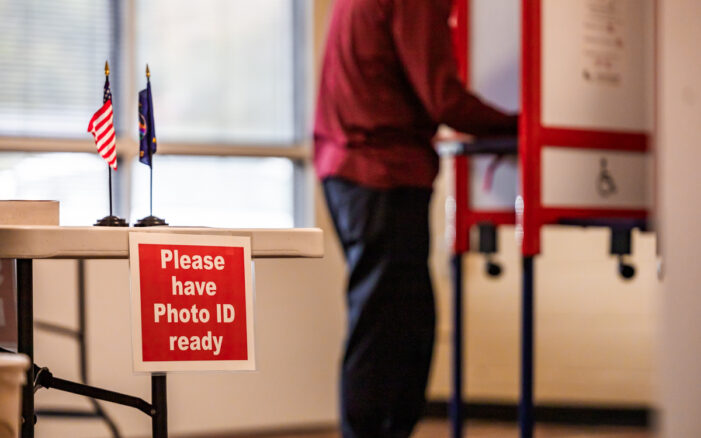
Because there is a constitutional amendment on the ballot, all Kansas voters — regardless of whether they are affiliated with a party or not — can cast a ballot in the Aug. 4 primary election.
Advance voting is currently underway. The deadline to request a mail ballot is Tuesday, July 28. Douglas County voters can do so through KSVotes.org.
Advance ballots mailed now might not reach election headquarters in time to be counted. There are ballot dropboxes around the county, and voters can also take their ballots to any polling place from 7 a.m. to 7 p.m. on Election Day.
In-person advance voting is available at the Douglas County election headquarters, 711 W. 23rd St., at the following times:
• 9 a.m. to 1 p.m. Saturday, July 25
• 8 a.m. to 6 p.m. on weekdays from Monday, July 27 through Friday, July 31
• 9 a.m. to 1 p.m. Saturday, Aug. 1
• and 8 a.m. to noon Monday, Aug. 3.
See in-person voting hours and locations for Lecompton, Eudora and Baldwin City on the county’s website at this link.
In-person voting will run from 7 a.m. to 7 p.m. on Election Day, Tuesday, Aug. 4. As long as you are in line to vote by 7 p.m., you will be allowed to cast your ballot.
Look up your polling place at this link. See what else will be on your ballot by visiting myvoteinfo.voteks.org/voterview/.
If local news matters to you, please help us keep doing this work.
Don’t miss a beat — get the latest news from the Times delivered to your inbox:
Click here to learn more about our newsletters first

Wulfe Wulfemeyer (they/them), reporter and news editor, has worked with The Lawrence Times since May 2025. They can be reached at [email protected].
Read their complete bio here. Read their work for the Times here.
More coverage: Election 2026
 Molly Adams / Lawrence Times

Latest Lawrence news:

 Cuyler Dunn/Lawrence Times
 Nathan Kramer / Lawrence Times