
Outcome points to narrowing of GOP majority to 68-57, smallest since 1992
TOPEKA — Voters in Kansas forced recalculation of partisan math in the Kansas House as Democrats flipped as many as 20 seats and crushed the Republican supermajority that allowed one-party domination of public policy debates for the past 16 years.
Unofficial results from Tuesday indicated Republicans absorbed losses in 15 House districts that voted for President Donald Trump two years ago in the presidential race. If preliminary counts were to hold, Republicans would retain a majority in the House, but the GOP advantage would shrink to 68-57. It would be the smallest working margin for House Republicans since 1992.
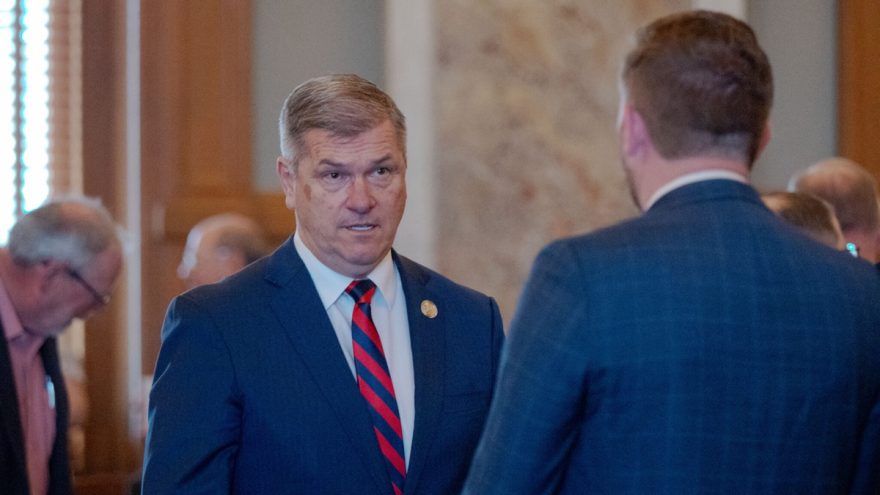
The blue wave that filtered to down-ballot races in the Kansas Legislature took out Republican House Majority Leader Chris Croft, an Overland Park Republican. He fell to Democrat Megan Phillips, also of Overland Park, by a margin of 51% to 49%. Croft was among contenders to become House speaker.
Croft’s loss in a district Trump carried by 6.1 percentage points in 2024 was in line with the evolving electoral landscape in Johnson County. Republicans were poised to surrender at least 10 House seats in the populous county in the Kansas City metro.
On Wednesday, Secretary of State Scott Schwab said his office would perform close-race audits of results in three House districts.
Don’t miss a beat … Click here to sign up for our email newsletters
Click here to learn more about our newsletters first
Schwab’s review would begin with the District 27 battle between Democrat Sara Kiewiet of Overland Park and incumbent Republican Sean Tarwater of Stilwell. At this point, Kiewiet had a 41-vote edge over Tarwater, who was in line to seek a role in GOP House leadership.
The secretary of state planned to review results in the 40th District involving Democrat Mika Stilwell and incumbent Republican David Buehler. In that Lansing showdown, Buehler was ahead with 3,806 votes to Stilwell’s total of 3,739. The other review would take place in District 117. Democrat Brandon Holland of Baldwin City held the edge at 6,566 votes to incumbent Shawnee Republican Adam Turk’s 6,433.
House Minority Leader Brandon Woodard, a Lenexa Democrat who didn’t have a Republican opponent, said fundraising, candidate recruiting, get-out-the-vote efforts and policy positions on the cost of living, public education and healthcare contributed to the surge among Democrats. The results demonstrated Kansans were convinced the state deserved better outcomes in the Kansas House, he said.
“This wave of victories is not only a testament to the devotion of our caucus and candidates, but of the dedication of Kansans to our state,” Woodard said. “By picking up this unprecedented number of House seats, we have effectively shattered the Republican supermajority and restored balance to the Kansas Legislature.”
Woodard said he had an uncomfortable front-row seat to the work of Republican House leaders who placed “divisive culture wars ahead of issues that matter the most to Kansas families” and advocated policies “designed to advance an extreme political agenda at the expense of everyday Kansans.”
During the 2026 legislative session, House Republicans dictated to Democrats during floor debates by virtue of their 88-37 advantage. With that two-thirds majority, Republicans in the House could disregard Democrats when voting to override vetoes by Democratic Gov. Laura Kelly or when considering whether proposed amendments to the Kansas Constitution went on statewide ballots.
The addition of Democrats to the House meant they would be assigned more seats on budget and policy committees and had an opportunity to block Republicans from compelling middle-of-the-night debates on controversial legislation.
Jason Probst, a Hutchinson Democrat, prevailed in a rematch against Republican Rep. Kyler Sweely, who defeated Probst in 2024. On Tuesday, Probst earned 53% of the vote against Sweely’s 47%.
“There was a moment last night where I looked out at all the people who came out to support me,” Probst said. “I took a deep breath, and I looked at all their faces. I looked in their eyes. I wanted to remember the emotion of two years ago, feeling so alone, looking out at a room full of people who had put so much time and energy into supporting me — only to have to tell them that I had failed. To feel that I had let them all down, that I had let my community down.”
Probst said the election was a first step in the process to create a political system that effectively served Kansans. He said worthwhile change would “require all of us to move from the established habits of old and demand something new.”
Rep. Adam Smith, a Weskan Republican who didn’t have an opponent in the Tuesday election, said he hadn’t planned to seek reelection until Senate President Ty Masterson, the GOP nominee for governor, blamed him for the Legislature’s inability to make meaningful progress on property tax reform.
“I may not even run in ’28,” Smith said. “I wasn’t going to this year until a certain someone decided to blame me for everything wrong with property taxes.”
As Smith considered his 100% approval rating among western Kansas voters, he shared a tongue-in-cheek idea about deriving a payback on behalf of Kansans who endured an avalanche of political advertising.
“I’m thinking we should have a surcharge/tax on political advertising that goes into a fund that is then 100% directly sent back to each homeowner in the form of a property tax rebate,” he said.
Kansas Reflector is part of States Newsroom, a network of news bureaus supported by grants and a coalition of donors as a 501c(3) public charity. Kansas Reflector maintains editorial independence. Contact Editor Sherman Smith for questions: [email protected]. Follow Kansas Reflector on Facebook and Twitter.
Don’t miss a beat — get the latest news from the Times delivered to your inbox:
Click here to learn more about our newsletters first