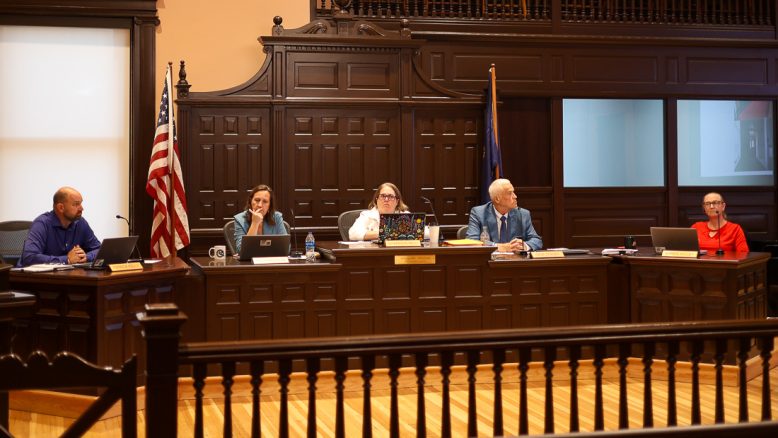

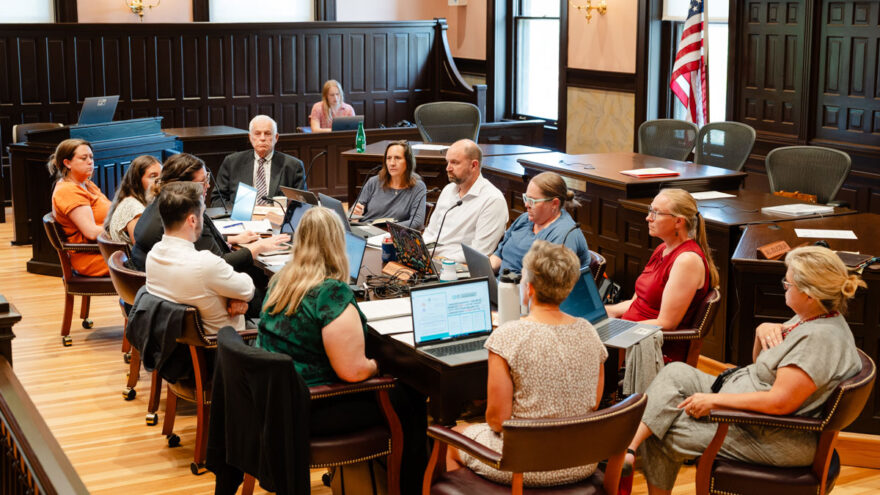
As Douglas County commissioners reviewed eviction prevention methods, presenters identified a need for greater public education on tenant-landlord issues, while representatives from Lawrence Tenants called for tenant right to counsel.
County commissioners heard from community partners on services and resources designed to assist households facing evictions in a work session Wednesday.
Commissioners do not take direct action during their work sessions, which are primarily for information purposes.
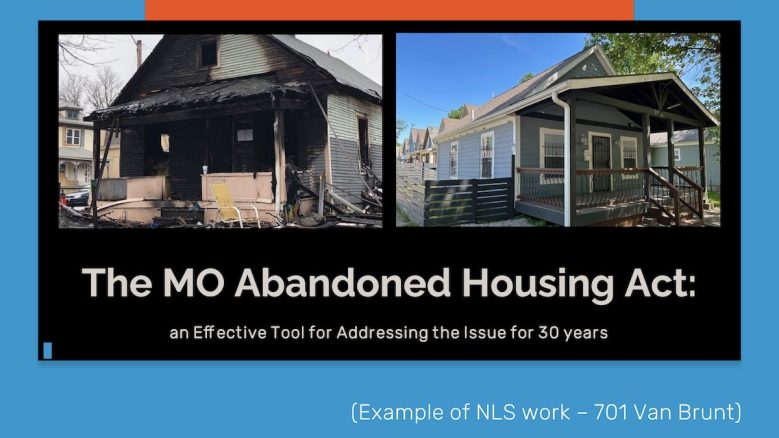
Commissioners reviewed a slideshow created by Jasmin Bates, AmeriCorps member, detailing steps in the eviction process. They also discussed causes leading to different types of eviction beyond three-day notices for nonpayment of rent, including 14/30 or 30-day evictions. Read more about these eviction types here.
Commissioner Gene Dorsey asked if people typically miss rent because they are unemployed or have issues with employability.
Responses made it clear that there is a miasma of social factors and health determinants that might cause someone to default on rent. In many cases, renters are just one or two unfortunate events away from snowballing toward eviction.
“I think that renters are very cost-burdened by housing,” said Kristen Egan, the Douglas County housing and human services program manager. “Our wages don’t keep up with the amount that it costs to rent here.”

Agenda materials looking at the county’s 2024 tenant experience survey said “The report suggested that over 50% of the homes in the county were renter-occupied, and 56% of those units considered themselves cost-burdened.”
Egan had seen cases where parents took off work to care for a sick child, resulting in a lost paycheck. Brynn Blair, managing attorney with Kansas Legal Services (KLS), said people with labor-preventing medical issues or individuals escaping domestic violence often struggle to meet rent.
At the same time, evictions cannot be expunged from a tenant’s record in Kansas, leading to increased difficulty in finding a new home.
The county currently has a $350,000 fund for rent and utility assistance. However, Jill Jolicoeur, assistant county administrator, said it’s difficult to gauge the efficacy of the program considering there is more demand than there are funds.
Tenant education and landlord accountability
County Commissioner Erica Anderson asked if it is allowable for the county to have stronger protections for its tenants. She additionally questioned how many renters know about county-funded supports, programs and services.
Adelaida Mendoza, the eviction resolution coordinator at the Douglas County District Court, has done outreach through the Lawrence-Douglas County Housing Authority and expressed interest in reaching out to Lawrence Tenants.

Due to a lack of education, relatively few tenants show up for answer hearings. These are court dates when tenants can affirm or deny the charges against them from the landlord. If a tenant does not show up for an answer hearing, the judge defaults to a ruling in favor of the landlord and issues a writ of restitution, which allows a sheriff to evict the defendant within the next 14 days.
“We’re seeing about 20% of people who are being evicted show up for that answer docket, roughly,” said Sam Allison-Natale, executive director of Kansas Holistic Defenders.
Blair believes many people avoid the answer docket when they cannot pay rent.
“They don’t think there’s anything else they can do,” Blair said. “And that’s something that, of course, through legal education, public education, we can really address.”
Blair said that KLS attempts to reach as broad an audience as possible, but they are ethically prevented from advertising their services to people on the record facing eviction. Rather, they have to hope that those individuals find their way to KLS or are referred. Many presenters faced a similar dilemma.

“I think the key to widening the attendance at the answer docket really needs to come down to the community organizations and commission and just like the resources in the community,” Blair said.
The work session additionally emphasized the need for education of landlords. In Lawrence, for example, landlords are required to renew their licenses once a year.
“We frequently see rental inspections lack teeth, even when there are egregious violations documented, very little often comes of it,” Allison-Natale said. “I think certainly there could be obligations as part of that rental licensing program related to how evictions are handled.”
Eviction mediation versus tenant right to counsel
Commissioners asked if mediation, which might take place before or after an eviction filing, is a viable option for improving eviction outcomes.
Many guest speakers reported that tenants were overall more willing to participate in mediation than landlords. When both parties do come to the table, it’s typically a pro se tenant speaking with a landlord’s lawyer.
Local renter advocacy group Lawrence Tenants is pushing for a tenant right to counsel, or TRTC, ordinance to be implemented at the county level. TRTC “guarantees all tenants in Douglas County the right to a lawyer when facing an eviction,” according their past presentations.
A number of the organization’s members spoke during the meeting’s public comment period, advocating for this ordinance over mediation.
“Self-represented tenants are typically unaware of their rights and unable to raise defenses or navigate the eviction system, putting them at a severe disadvantage,” said Matt Dickey, of Lawrence Tenants. “Mediators and other non-legal providers are not able to argue on behalf of tenants in court or even help them identify a valid counterclaim, leaving the core power imbalance unaddressed. There is no substitute for full legal representation for tenants in our rights.”
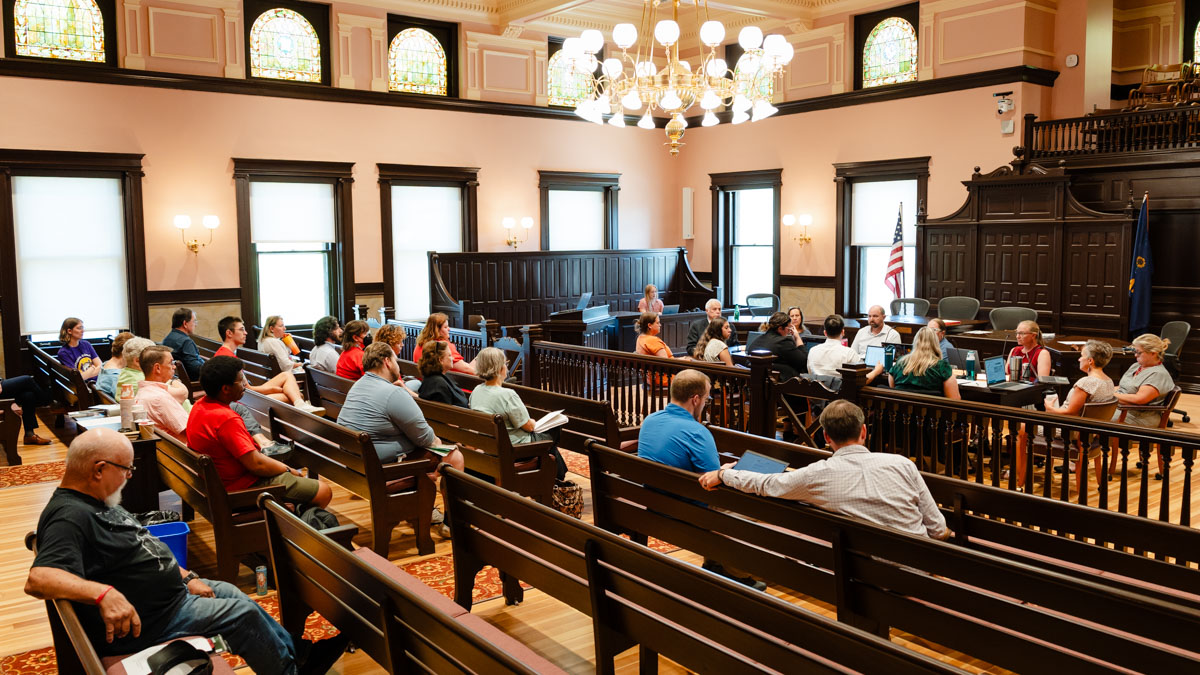
Vince Munoz, of Lawrence Tenants, said he spoke with mediators in Johnson County. He learned that they do not have legal training and “they don’t actually know landlord-tenant law.” Furthermore, if the landlord admits to illegal acts, the mediator cannot break neutrality to inform tenants of rights violations.
Cornelius Baker additionally reminded commissioners that the county had expressed commitment to implementing a TRTC ordinance in the joint city-county housing and homelessness strategic plan called “A Place for Everyone,” which “specifically focuses on housing justice and access for particularly marginalized groups.”
Lawrence Tenants will present on TRTC with the National Coalition for Civic Right to Counsel in another Douglas County Commission work session Sept. 3.
If local news matters to you, please help us keep doing this work.
Don’t miss a beat … Click here to sign up for our email newsletters
Click here to learn more about our newsletters first
Resources for renters and tenants
Tenant issues and rights:
• Read about the rights Kansas tenants have and issues that could come up before, during and after tenancy from Kansas Legal Services.
• Find more info and connect with Lawrence Tenants.
Evictions:
• Learn about the eviction process from the Kansas Judicial Branch at this link.
• Check out the self-help page on the Douglas County District Court’s website at dgcoks.gov/district-court/self-help for resources and helpful forms.
• Find the Kansas Judicial Branch’s eviction expungement portal online at this link.
City of Lawrence fair housing help:
• Find information about the city’s fair housing civil rights enforcement procedures and a form to initiate a complaint on the city’s website at lawrenceks.org/attorney/fairhousing, or call 785-832-3310.
Rental assistance:
• Apply for help from the Douglas County Housing Stabilization Collaborative via the county’s website at this link.
• Apply for the Low-Income Energy Assistance Program, LIEAP, at this link during colder months to help cover home energy costs.
• Find more resources to help with rent and utility payments on the Lawrence Public Library’s website.
News coverage:
• See the latest articles from The Lawrence Times on the following topics: homelessness and housing; renter rights; source of income discrimination; affordable housing; tenant right to counsel

Wulfe Wulfemeyer (they/them), reporter and news editor, has worked with The Lawrence Times since May 2025. They can be reached at [email protected].
Read their complete bio here. Read their work for the Times here.
Latest Lawrence news:

 Jacob Rice / Lawrence Times
 Logan Pierson / Lawrence Times


More coverage of housing and homelessness:
 Wulfe Wulfemeyer/Lawrence Times