

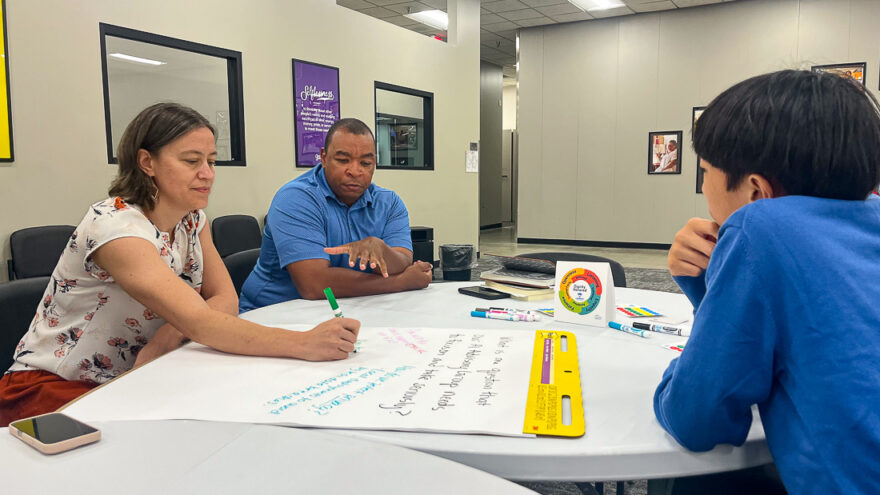
Members of the Lawrence school district’s AI committee raised concerns Tuesday about the integrity of learning and whether families should be able to opt in or out of AI usage.
Jake Potter, district spokesperson, said the Kansas State Department of Education does not have artificial intelligence usage guidelines, leaving it up for individual districts to start discussing their own policies.
The district sought applicants for the Generative AI & Emerging Technologies Advisory in November. The committee is made up of 23 members including school board members GR Gordon-Ross and Matt Lancaster, eight parents, seven district staff members, four community members and two district students.
Tuesday’s was their fourth meeting. Committee members based much of their discussion on results of an AI survey. Responses called for opt-in consent from parents rather than automatic participation in AI usage in classrooms.
Don’t miss a beat … Click here to sign up for our email newsletters
Click here to learn more about our newsletters first
Members also said that systems should be transparent, follow federal student privacy regulations and offer AI-free alternatives for families who choose not to participate.
Please support
The Lawrence Times!
Subscribe here.
While much of the brainstorming had to do with how AI could play a role in education in the future, multiple committee members said it was important to ensure AI would be helpful for learning in the first place.
“I’m worried that we’re asking the wrong questions about how we are going to get AI into our schools in a good way or how we are going to use AI,” Christin Bowman, a parent on the committee, said. “I think that is the next question. And the first question is actually how does AI help students learn? Does it at all? These are schools, so, you know, the goal is to learn. And to learn, you have to struggle.”
Committee member Parker Curl, a University of Kansas computer engineering student, believes AI has no place in an elementary school.
“I think elementary is a really good place to keep things traditional. I am a big believer, and that’s the building blocks,” Curl said. “You’re learning how to read, write, count — I really don’t find any reason for there to be AI in a place like that.”
Katherine Morse, a committee member and district parent, said she once saw students’ faces had been run through an aging system to show them as older versions of themselves. She said she would not have wanted her children to participate and worried the images could become part of a data system that could be leaked.
Morse said her children were affected by a previous district data leak, and their Social Security numbers were posted online.
She said she wanted to make sure any AI tools were scaled for different age groups, with younger students spending less time on screens or using AI tools.
“We should always remember that students, all of our students, are children,” Morse said.
Several members said they did not want to send students the message that AI will take their jobs, especially those in creative fields. The group wants to be mindful of protecting students’ creativity and critical thinking skills.
The conversation also centered on the role of AI for teachers and students. District parent Carrie Poe said she would like to see the district try to engage parents to help them understand the role of AI in education.
The group also discussed how to maintain learning integrity.
Daniel Dao, an eighth grade student at the Lawrence Virtual School, said he thinks the challenges posed by AI offer a chance for schools to focus on getting students to understand the reasons behind why they learn.
Zach Harwood, Lawrence Virtual School principal, said he would not want any AI tool the district uses to have a personality or appear like a friend.
Stories and studies have spread online of minors forming close emotional bonds with AI chatbots, which have sometimes driven kids to mental health crises and even suicide.
Some committee members spoke about trying to learn from the way the internet and search engines changed learning.
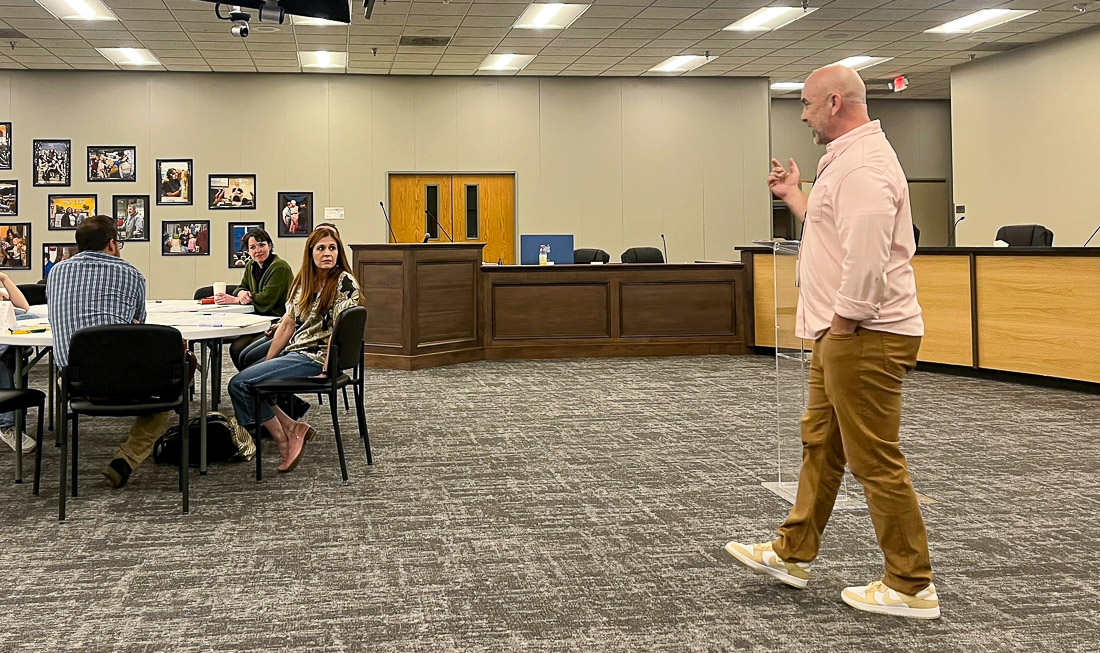
Harwood said schools no longer focus as much on making students memorize facts and dates, since that information is almost always readily accessible online. He wondered how AI may force similar education adjustments and said the district should prepare.
Committee members said they wanted the district to engage in ongoing review of AI tools. Potter said the committee would likely continue to meet and review district policy on the topic for the foreseeable future.
“There’s passion around this topic, there’s concern, and I think there’s also hope and optimism,” Potter said.
The next meeting date has not yet been announced, but meetings are open to the public.
If local news matters to you, please help us keep doing this work.
Don’t miss a beat — get the latest news from the Times delivered to your inbox:
Click here to learn more about our newsletters first

Courtney Lane (she/her), reporting correspondent, has worked with The Lawrence Times since April 2026. Originally from Arkansas, she’s a graduate of KU’s Journalism school, where she worked as a reporter, opinion section editor, and eventually editor-in-chief for The Kansan.
Read her work for the Times at this link, and see her photography for the Times at this link.

Cuyler Dunn (he/him), staff reporter, has worked with The Lawrence Times since April 2022. He can be reached at [email protected].
Read his complete bio at this link. Read more of his work for the Times at this link.
Latest Lawrence news:
 Jacob Rice / Lawrence Times

 Jacob Rice / Lawrence Times
 Logan Pierson / Lawrence Times