

Inside a room of dark blue cloth, soft light and layered patterns, Wabwila Mugala’s “Quilted Existence” asks viewers to do more than look.
The installation, which opens Friday at the Lawrence Arts Center, uses indigo-dyed broadcloth, printmaking and resist-dye techniques to explore resilience, creativity and knowledge across the African diaspora.
Mugala said she made the show immersive because she wants people to physically move through the space and interact with the work instead of just looking at it on the wall. She plans to drape pieces from the ceiling using copper rods and have people weave in and out.
“I really like the idea of walking into something,” she said. “Like, oh, I’m gonna look here, and then I’m gonna look there, and then I’m gonna go to this wall, and then I’m gonna go to the other wall.”

Mugala, a multimedia artist born in Zambia, creates work using printmaking and textiles.
After graduating from University of North Carolina Greensboro, Mugala spent several years working in corporate graphic design while continuing to make art. Trying to balance art and work pushed her to think deeper about what attracted her to art. That led her to collage, working in sketchbooks with archival Black magazines like Ebony and Jet.
Don’t miss a beat … Click here to sign up for our email newsletters
Click here to learn more about our newsletters first
Over time, she began layering patterns and enlarging images, which led her toward a deeper interest in surfaces, repetition and materials — the conceptual gateway to textiles.
“I’ve always been interested in adornment,” she said. “I was born in Zambia, so a lot of very rich textiles on a daily basis, that my mom wears around the house, or that you carry your babies in, things like that.”
Working on her Master of Fine Arts, she studied the history of textiles in her region and the African diaspora, including how patterns emerge from ecology, ritual and culture.
The color also comes from her move to Lawrence. Her previous work had always been warm-toned with oranges and reds, especially while living in Arizona. However, when she moved here, she felt compelled to change to a more neutral, calm color.
“But indigo is also like this, very alive,” Mugala said. “You have to watch over and take care of, and that was something very new for my practice. That felt really nice. Caretaking is involved in the whole process.”
Last summer, Mugala read “Black in Blues” by Imani Perry, about how blue and indigo manifest in African diasporas through the Caribbean, Africa and the Carolinas, and how blue tied them all together.
“Blue is a bit more meditative,” Mugala said. “You can sort of ease into it.”

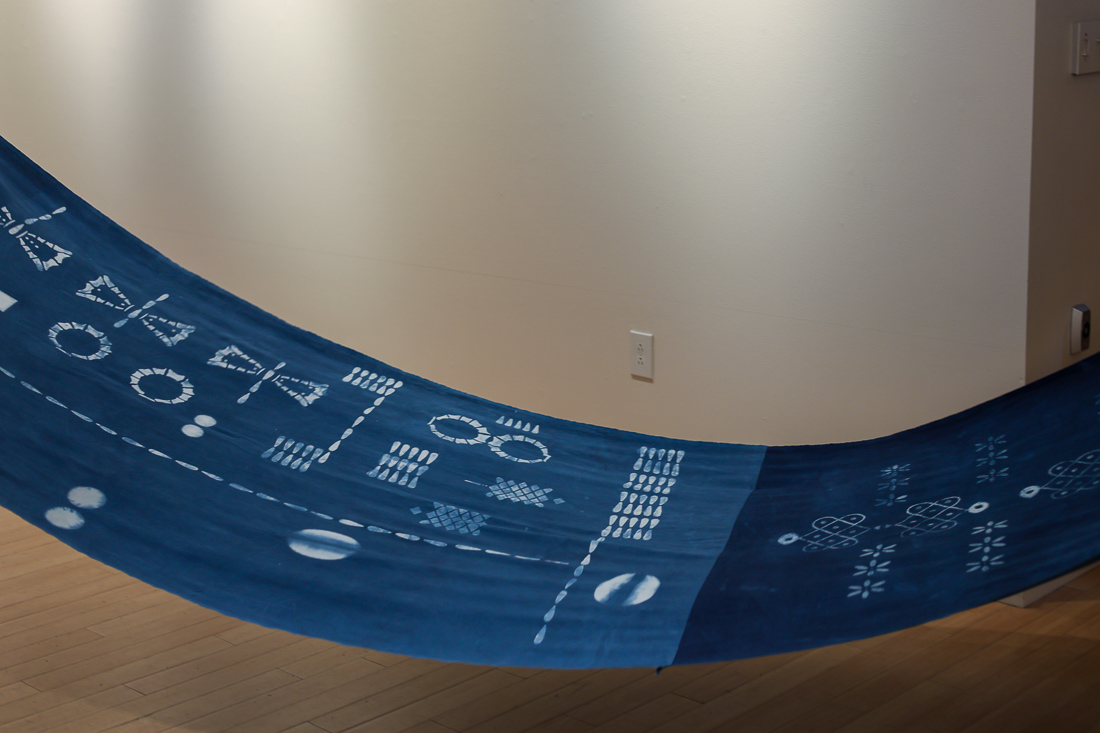
The textiles for the show were created using a stencil-based clay resist indigo dye method. She borrows techniques from batik textiles, which use wax, but screen prints with clay instead.
Typically she uses carved stamps, but for this collection, she used plastic stencils that let her move the patterns freely across the fabric. She places the stencil on the fabric and uses a small squeegee, like in screen printing, to pull the clay resist, which is the consistency of heavy cream, over the stencil and let it dry completely. This will block the indigo dye applied to the fabric.


The dye comes from the Indigofera plant and is created by grinding up the leaves of the plant. When removed from the dye bath, the fabric is a light green and then oxidizes into the indigo.
For Mugala, the materials used in the work carry meaning beyond their surface. Broadcloth, cowrie shells, beads and sewn fabrics become layered symbols, each carrying its own history of adornment, commerce, spirituality and exchange.
“I’m really interested in that right now, like hope, like, people finding connection and kinship with each other,” Mugala said. “It’s both literally quilting some of these together, and also that we’ve always existed together.”

She said she thinks of the patterns and symbols in the work as a kind of glossary, though not meant for one-to-one translation.
“I’m way more interested in what you see or don’t see,” Mugala said. “I know what this means to me, but I don’t know if you just see, like, a blob. That’s also interesting.”
A motif might be read as a code, a star, a bird, a landscape or something entirely different, depending on the viewer’s own background and memory.
The openness is central to the way she approaches cosmology and Indigenous symbol systems. She is interested in patterns as knowledge holders, not just decoration. Some of the designs in the show are inspired by Indigenous Zambian language systems and other visual traditions that were once drawn in sand or passed down through community knowledge rather than preserved on cloth.

She also said she thought about children when shaping the installation, and how people of different heights and abilities might encounter the work. She wanted the hanging pieces to feel immersive for someone small and expansive for someone tall while still inviting a range of interpretations.
Mugala said she applied to the arts center because of its community-minded atmosphere, its support for artists and its strong culture around craft and natural dyes. After moving from Arizona, she said Lawrence felt wholesome and restful. The city’s walkability, its greenery and the slower pace of life all gave her room to think differently about her practice.
Mugala said she is still figuring out what comes next, including a shorter paper-making residence in upstate New York, but the larger question she returns to is what home means.
Born in Zambia, raised in Sweden and later living in the Northeast, North Carolina and Arizona before Kansas, she said she has moved enough to know that the idea of home can be complicated.
“I live everywhere and nowhere,” she said, describing the push and pull of life shaped by migration.


If local news matters to you, please help us keep doing this work.
Don’t miss a beat — get the latest news from the Times delivered to your inbox:
Click here to learn more about our newsletters first

Courtney Lane (she/her), reporting correspondent, has worked with The Lawrence Times since April 2026. Originally from Arkansas, she’s a graduate of KU’s Journalism school, where she worked as a reporter, opinion section editor, and eventually editor-in-chief for The Kansan.
Read her work for the Times at this link, and see her photography for the Times at this link.
Latest Lawrence news:
 Cuyler Dunn/Lawrence Times