
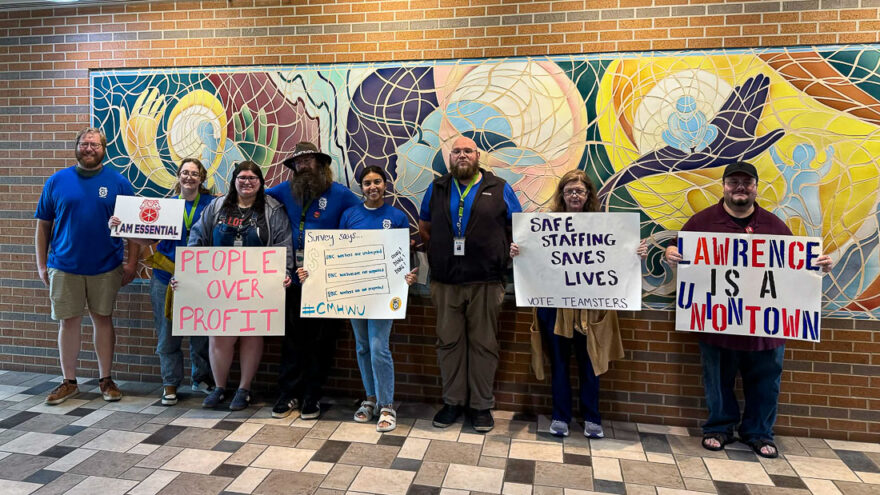
Bert Nash Community Mental Health Center employees will soon vote on whether to unionize in an election that some workers said they feel will determine their voice in workplace decisions, caseload safety and trust in management.
“I wouldn’t be here if I didn’t think that Bert Nash as an agency and its role in the community (were) worth fighting for,” employee Howard Callihan said. “I feel like the agency is at serious risk of losing the plot.”
Callihan, a Projects Assisting in the Transition from Homelessness case manager, and others said the center’s current labor fight is driven by frustration with management, staffing shortages, low pay and what they described as an aggressive campaign to discourage support for unionizing with Teamsters Local 696.
Bert Nash employees are set to vote June 25 on whether to be represented by the Teamsters union after previously unionizing under IBEW Local 304 with an overwhelming majority vote in 2024. After more than 100 hours of negotiations, the IBEW on May 22 filed a disclaimer of interest withdrawing their representation of Bert Nash workers, according to an emailed statement from Bert Nash CEO Kirsten Watkins.
Callihan and other workers last month asked management for voluntary recognition of Teamsters representation of the union and were denied, prompting the upcoming National Labor Relations Board-supervised election. Teamsters union rep Austin Wilson started a change.org petition calling on Bert Nash to recognize the union and address workplace concerns. It had received more than 830 signatures as of publication time.
Don’t miss a beat … Click here to sign up for our email newsletters
Click here to learn more about our newsletters first
Workers said the real issue is not which union represents them, but whether management is willing to listen to frontline staff at all.
“We want a seat at the table to be able to have our opinions heard and to be involved in making those policies and the procedures,” said Amy Munsterman, a licensed practical nurse at the Treatment and Recovery Center. “We’re the ones ultimately seeing the impact of not having clear and consistent policies. We see it every day.”
Several workers said management feels increasingly disconnected from day-to-day realities.
Please support
The Lawrence Times!
Subscribe here.
Darci Kampschroeder, a case manager in supportive housing, said frustration with “out of touch” management has been building for years, especially around pay and HR.
“Going to try to solve anything with HR is like running into a brick wall,” she said. “I just feel like I’m working in a black hole.”
Kampschroeder said a recent morning team meeting was led by a union consultant rather than her manager, which she described as “really weird and awkward.”
“It seems like the way that management is responding to and has been responding to our unionizing efforts is stonewalling and double dealing and trying to demoralize those of us that are committed,” Callihan said.
Workers said that feeling has only deepened as Bert Nash has brought in consultants from the American Labor Group and stepped up anti-union messaging, including launching a website, bncelection2026.com. Some said the messaging has framed the consultants as neutral, even as workers believe the goal is to sway the election outcome.
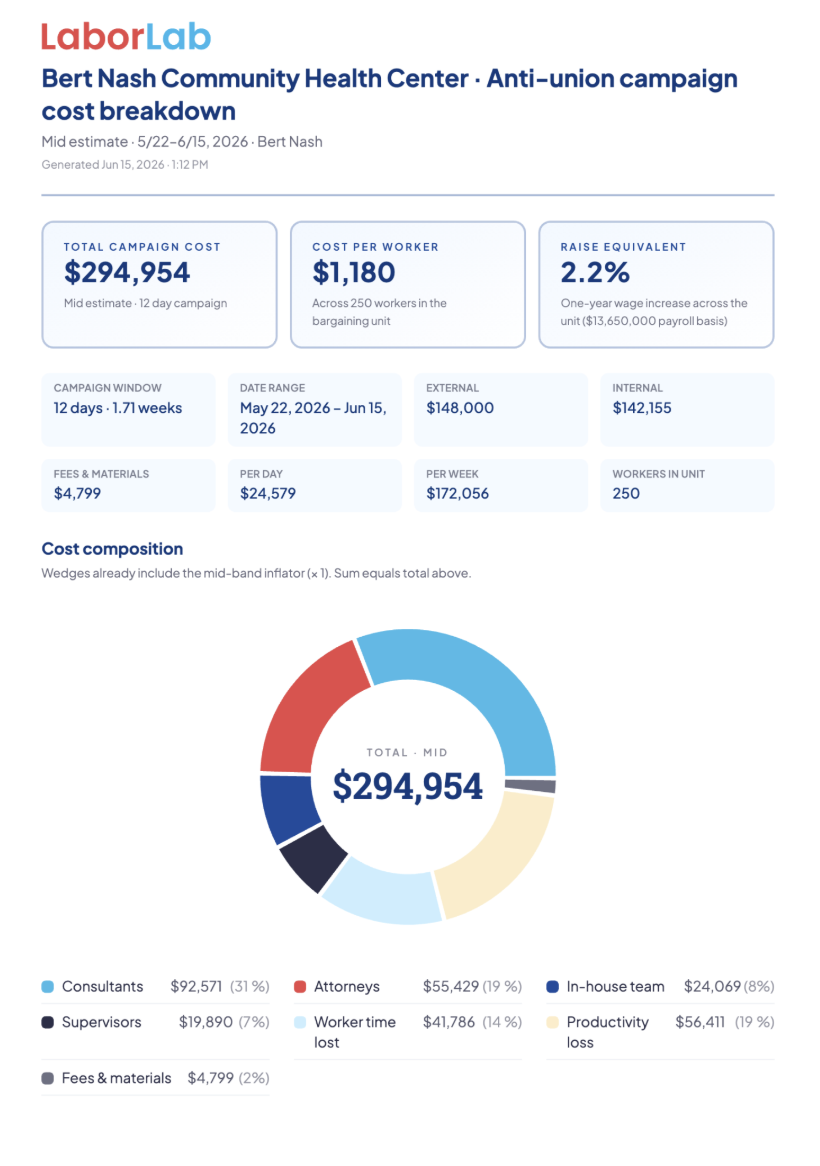
LaborLab, a nonprofit that tracks corporate spending on union busting, estimates that as of Monday, Bert Nash has spent $148,000 on external consultants from the American Labor Group and attorneys with Spencer Fane.
The estimate projects consultant costs based on hourly rates, travel, lodging and time spent during the campaign. It lists consultants at an assumed $400 per hour for eight-hour days, plus lodging and travel expenses, and attorneys at an assumed $500 per hour for weekly legal work. The numbers are based on previous work ALG has done, as reported to the government.
They also estimate a loss of $142,155 internal costs, accounting for time attributed to campaign leaders, supervisors, worker time lost and projected productivity losses.
Case manager MaKayla Reed said Bert Nash bringing in the consultants hurt.
“I didn’t think that this organization would choose to spend their tight budget on meetings that exclude employees who are working towards making this a better place for everyone,” they said.
Watkins said in her statement that “The Bert Nash Center respects the rights of our team members to support or not support the Teamsters union. We have and will continue to follow our obligations under the law.” She did not respond to specific questions, including whether the center had hired ALG to speak with employees.
Some workers said staffing shortages and high turnover have left employees burnt out, stretched thin and affecting the level of client care provided.
“I mean, our working conditions are the community’s therapeutic and healing conditions,” Callihan said.
Munsterman said the problems are especially troublesome at the Treatment and Recovery Center, where workers say short staffing and changing duties have made it harder to provide consistent care.
“All we want to do is make the environment safer for our clients, for ourselves, and I think to know that it is OK, and possible, to be both things — to be someone that cares greatly about Bert Nash and this community, and continuing to set a high bar and meet that bar, and to also be someone who supports the union, who will be there with us,” she said.
Jordan Claeys, a crisis therapist at the center, said workers want a union because they believe management has not listened to them on basic workflow and staffing issues. For instance, a recent policy change added mobile-response duties to her position at the TRC, which she said added pressure to an already difficult job.
“It wasn’t something that we received any sort of say in,” Claeys said. “It was a, ‘You do this, you follow the instructions that we’re giving you, or you are insubordinate.’”
Reed said workers are trying to keep up with large caseloads, but that turnover makes it hard to sustain care.
“I think that having a union is important for every worker, especially in Kansas. Kansas employment law doesn’t afford a lot of rights to workers,” they said.
Workers said the Teamsters campaign reflects a broader belief that frontline staff need more protection and more leverage when talking to management.
“We can’t operate in that way, if whether or not we’re treated similarly is conditional,” Callihan said. “It can’t be about whether management decides to take us seriously, to treat us with equity.”
He said workers feel they are being managed through pressure rather than dialogue.
“We’re aware when we’re being mollified and pushed around,” he said.
For Kampschroeder, the union is also about the practical reality of trying to do the job without getting buried under constant demands.
“I’d be willing to pay dues to have somebody say ‘No, this is the way it’s gonna be,’” she said. “Tell management, ‘This is the way it’s gonna have to be.’”
Callihan said the organization’s board and executives should be focused on protecting the agency’s mission, not only its structure.
“I’m sure that the main thing on our administrative and board’s minds are just trying to make sure that the organization continues to exist, but I mean, we are the organization,” he said.
If local news matters to you, please help us keep doing this work.
Don’t miss a beat — get the latest news from the Times delivered to your inbox:
Click here to learn more about our newsletters first

Courtney Lane (she/her), reporting correspondent, has worked with The Lawrence Times since April 2026. Originally from Arkansas, she’s a graduate of KU’s Journalism school, where she worked as a reporter, opinion section editor, and eventually editor-in-chief for The Kansan.
Read her work for the Times at this link, and see her photography for the Times at this link.
More union news:

Bert Nash workers soon to vote on whether to unionize with new representation
Latest Lawrence news:
 Wulfe Wulfemeyer/Lawrence Times
 Wulfe Wulfemeyer/Lawrence Times