
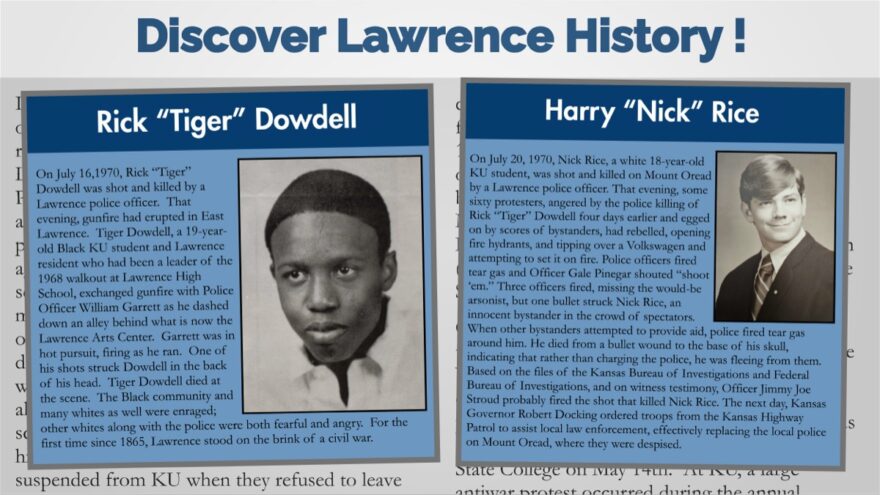
The Lawrence community is invited to a commemorative program to honor two teens who were shot and killed by Lawrence police in 1970.
Rick “Tiger” Dowdell, 19, and Nick Rice, 18, were killed in a four-day span marking one of the more tumultuous periods in Lawrence’s history, which would later come to be known as the “Days of Rage.” Police and the local newspaper spread disinformation widely in the aftermath.
The teens’ lives are also being honored with historic markers that will be unveiled on the anniversaries of their deaths.
The main commemorative program is set for 2 p.m. Sunday, July 12 at the Watkins Museum of History, 1047 Massachusetts St.
“The event will share the stories behind two new educational markers and reflect on the lasting importance of learning from our community’s history,” according to information provided by the city.
Don’t miss a beat … Click here to sign up for our email newsletters
Click here to learn more about our newsletters first
The marker for Dowdell will be unveiled at 7 p.m. Thursday, July 16 near the old Salvation Army building at the south entrance of the alley between New Hampshire and Rhode Island streets.
The marker for Rice will be unveiled at 7 p.m. Monday, July 20 at 1241 Oread Ave., across the street from the Mississippi Street parking garage near the Kansas Memorial Union.
Please support
The Lawrence Times!
Subscribe here.
The events will honor Rice and Dowdell, as well as “their families, and the community members and organizations who helped make the educational markers possible,” according to the city.
Chris Rice, the brother of Nick Rice, initiated the request for the markers, and they have been in the works since August 2020. He told the Historic Resources Commission in November that he hoped he’d live long enough to see the markers placed. Lawrence city commissioners gave the markers final approval during their Feb. 10 meeting.
The markers are 18-by-24-inch panels on pedestals. The markers and their installation cost the city less than $100 because a private donor agreed to pay for the markers.
Background
Using hundreds of pages of state and federal investigatory records, this publication in 2021 and 2022 wrote expansive series on Rice and Dowdell’s killings. Those series will be featured on the Watkins Museum of History’s website linked with the QR codes on the markers.


Dowdell was killed by Officer William Garrett on July 16, 1970, shot in the back of the head while running down an alleyway near the 900 block of New Hampshire Street. Gunfire rang out in Lawrence earlier in the evening; Dowdell and his friend were traveling in a yellow Volkswagen and were followed by Garrett and his partner Kennard Avey, ostensibly suspected of being part of the gunfire.
The Volkswagen ran two stop signs and drove up on a curb before Dowdell exited the passenger’s side and sprinted down the alleyway. Exactly what happened in that alleyway is likely lost to history — but Garrett fired a warning shot, Dowdell allegedly returned fire, and then Garrett fired three more shots, one striking the teenage activist in the back of the head, killing him instantly.
Lawrence erupted in protests following Dowdell’s death. And though a sense of calm seemed to have returned to the city by July 20, Rice — a KU student accompanied by his fiancée of just two days and a mutual friend — came to Lawrence to pay a traffic ticket and would not return home.
After finding the traffic court closed for the night, the three decided to hang around Lawrence, playing pinball at a dive bar in the location that is now the Oread Hotel. A crowd grew outside of the bar, though, and the evening soon turned deadly. Rice was shot in the back of the neck that night by a bullet fired from the carbine rifle of Lawrence police Officer Jimmy Joe Stroud as police unleashed tear gas in a sea of chaos that enveloped the Oread Neighborhood.
Stroud, just hours later, would essentially confess to shooting Rice — first telling a group of local officials at the Douglas County Courthouse that he “thought he had shot someone,” and later asking the assistant county attorney and superintendent of the Kansas Highway Patrol, “Am I to be charged with shooting the man?”
Yet in the days and weeks following, the Lawrence Police Department and area officials launched a disinformation campaign, echoed broadly by the legacy newspaper in town, about Rice and the events of that evening — sowing public doubt regarding whether police were actually responsible for the teen’s death and helping propagate an impossible theory that Rice was shot by a mysterious sniper.
Neither Stroud nor Garrett faced legal consequences for their roles in the killings, and though Garrett left Lawrence shortly after Dowdell’s killing, Stroud worked for LPD for another seven years.
If local news matters to you, please help us keep doing this work.
Don’t miss a beat — get the latest news from the Times delivered to your inbox:
Click here to learn more about our newsletters first

This post is by the Lawrence Times news team.
If you have news tips, questions, comments, concerns, compliments or corrections for our team, please reach out and let us know what’s on your mind. Email us at [email protected] (don’t forget the KS!), or find more contact info and a quick contact form at LawrenceKSTimes.com/contact.
Follow us so you won’t miss the local news that matters most to you:
Latest Lawrence news:
 Debi Taylor/Contributed photo
 Nathan Kramer / Lawrence Times
 Cuyler Dunn/Lawrence Times