

Two Democrats are running to represent parts of northern, northwestern and central Lawrence as the Douglas County commissioner for District 1.
Democrats Patrick Kelly (incumbent) and Milton Scott will face off in the Tuesday, Aug. 4 primary election. Barring highly unusual circumstances, the primary election will likely decide the commissioner who will be elected to the seat.
We asked candidates about the top issues driving them to run, whether the county should implement a moratorium on data centers and more.
We did not give candidates a word count limit but advised them to keep answers concise. Candidates’ answers appear below verbatim, minus minor typos edited for clarity.
Will this race be on my ballot? Check which Douglas County Commission district you’re in at myvoteinfo.voteks.org.
All registered Kansas voters are eligible to vote in the primary election because there’s a constitutional amendment on the ballot. Early voting begins Wednesday, July 15. Voters can request a ballot to vote early by mail through Tuesday, July 28 at KSVotes.org. Polls are open from 7 a.m. to 7 p.m. on Election Day, which is Tuesday, Aug. 4.
Find out more at lawrencekstimes.com/election2026.
Jump to a topic:
• Meet the candidates
• Experience and qualifications
• Top 3 issues
• Property taxes
• Data centers
• Tenant eviction defense
• Nonprofit partners
• Commission expansion, dynamics
• Other issues
• Question for your opponent
• Free space
• Just for fun
Don’t miss a beat … Click here to sign up for our email newsletters
Click here to learn more about our newsletters first
This district
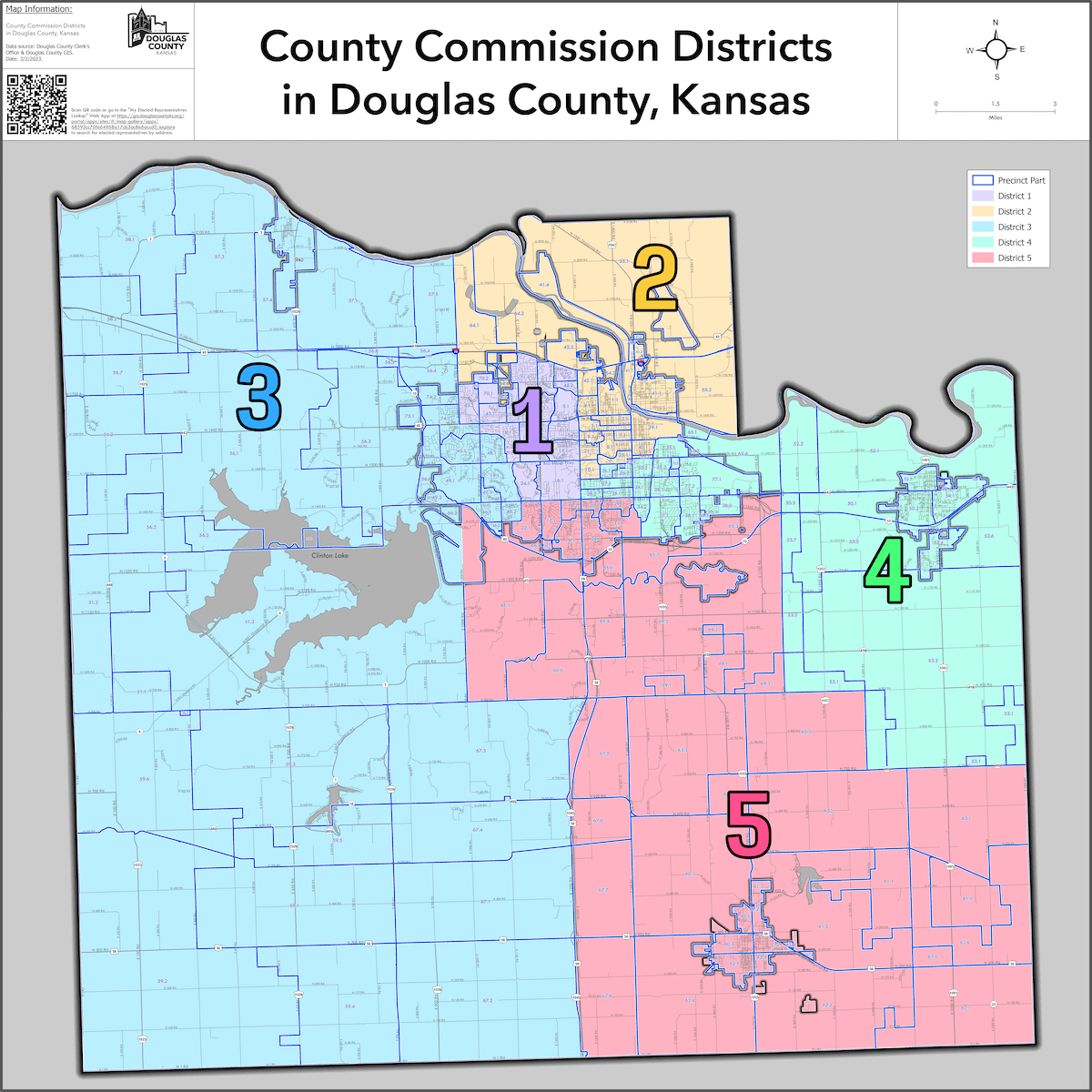
District 1, the small, purple district on this map, is the only county commission district that is fully within Lawrence city limits.
Its northernmost boundary is Interstate 70. In some places, District 1 reaches as far south as Clinton Parkway. Its eastern boundary is Iowa Street.
The western boundary is a bit more complex. North of Sixth Street, the westernmost boundary is Queens Road. The boundary runs along Sixth, dipping south again on Wakarusa Drive to include the area north of Harvard Road.
The western boundary continues south on Wagon Wheel Road, then along Crossgate Drive south of Bob Billings Parkway and south to Clinton Parkway.
Click here to open a big zoomable PDF map of the district in a new tab.
Meet the candidates

Patrick Kelly
Running as: Democrat
Pronouns: he/him
Hometown, and time in Douglas County: I grew up in Long Beach, California and moved to Lawrence in 1989
Where you currently reside: Lawrence
Day job: Retired public school educator. I am a teacher for the Kansas Leadership Center.
How voters can reach you: [email protected] / 785-377-9319
Campaign website, social media links: patrickkellyfordouglascounty.com
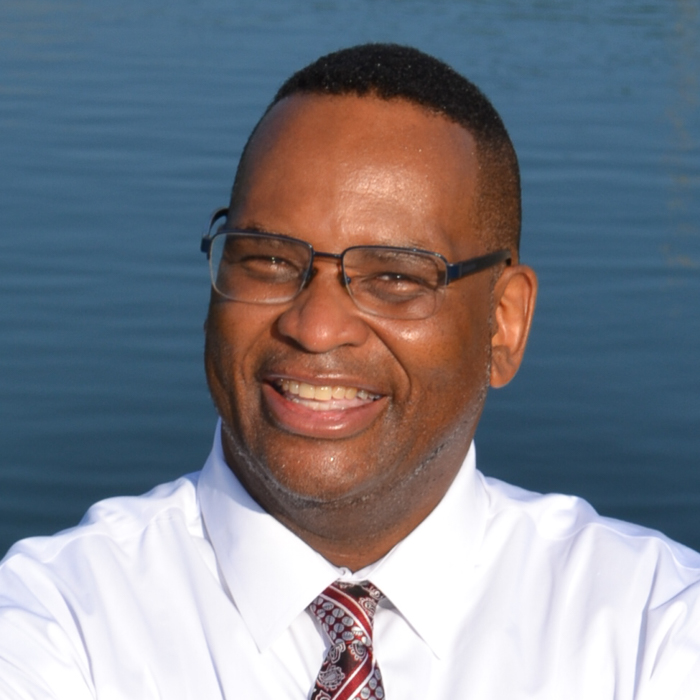
Milton Scott
Running as: Democrat
Pronouns: he/him
Hometown, and time in Douglas County: I grew up in public housing in East St. Louis, Illinois. I have lived in Lawrence 46 years since moving here in 1980 to attend the University of Kansas.
Where you currently reside: Lawrence
Day job: Adult Service Officer and Coordinator for the Community Service Work Program for Douglas County Criminal Justice Services.
How voters can reach you: [email protected]
Campaign website, social media links: MiltonScott.com
About you and your positions
Q: What specific experience and qualifications do you possess that make you the best candidate for the seat you seek?
Kelly: The most important qualification for serving as County Commissioner isn’t having all the answers. It’s knowing how to listen, ask good questions, and bring people together to solve difficult problems.
My career has prepared me to do exactly that. During 31 years in public education, I worked with students, families, educators, and community partners to navigate complex challenges and find common ground. Six years on the Lawrence-Douglas County Planning Commission taught me how today’s land use decisions affect our community for generations. During my eight years on the Douglas County Commission, I’ve learned that good decisions require balancing competing priorities, thinking for the long term, and earning the public’s trust.
Those experiences have prepared me not only to understand today’s challenges but also to help Douglas County navigate whatever comes next.
Scott: I have spent decades creating paths to stable housing for our most vulnerable neighbors. I wrote and administered grants for federal programs including Moving to Work (MTW), Transitional Housing, public housing, and Section 8. I oversaw the HOPE House program that housed chronically homeless individuals with severe and persistent mental illness.
At the beginning of my career, I worked in the private sector as a leasing agent for a local rental property and then served as an Assistant Director of Admissions and an Assistant Director for Student Housing at KU. I served as Director of Programs and Property Management with the Lawrence-Douglas County Housing Authority for over 20 years, then as Executive Director of the Kansas City, Kansas Housing Authority, before retiring from that position.
Additionally, I garnered experience as a Child Placing Agency Specialist with DCCCA, and served as Youth Care Worker for The Villages, Inc. I also have experience as a Juvenile Correctional Officer. I bring a balanced, real-world perspective to criminal justice and community safety.
As a single parent I raised two sons in Lawrence and am a proud grandfather to three grandchildren. I understand the challenges and joys of raising a family in Lawrence and Douglas County.
Q: Please list the top 3 issues motivating you to run for this office. What concrete ideas do you have to make a difference on each issue if you are elected?
Kelly: First, we must make it easier for people to live in Douglas County. Too many people are feeling squeezed by higher housing costs, the rising cost of everyday life, and increasing property values. Together, they’re putting real pressure on households across our community, especially seniors and others living on fixed incomes. We need responsible budgeting, long-term planning, and thoughtful economic growth that broadens the tax base so Douglas County remains a place where people can afford to build their lives.
Second, we must preserve what makes Douglas County such a special place to call home. As growth and development pressures continue, we need clear, community-driven expectations that protect our natural, historic, and cultural resources while ensuring new development is compatible with our community’s values and long-term goals.
Finally, we need to continue building on the partnerships that provide support when people need it most. Whether someone needs behavioral health care, help staying housed, services as they age, or support during a difficult time, our community works best when we invest early, measure results, and build strong partnerships.
Scott: I decided to run for the Douglas County Commission in District 1 because I believe our community deserves a local government that listens carefully, acts responsibly, and works collaboratively. My candidacy is rooted in three priorities based on my experience and my vision for Douglas County’s future.
1. Reduce Douglas County Property Taxes: We have seen extraordinary increases in property valuations. That should not come with the same extraordinary increases in property tax collections. I will push for targeted reductions and implement structural reforms to ease the burden on homeowners and businesses while keeping county government services funded.
2. Identify Spending Savings to Eliminate Government Waste: Government must be accountable. I will pursue aggressive cost saving measures, performance audits, and efficiency reforms to eliminate waste and ensure taxpayer dollars are used wisely by starting with a freeze on merit pay for County Commissioners. I will seek transparency to report the fund balances of all accounts.
3. Collaboration with Local Cities and School Boards: Progress happens when we work together. I will work to build strong partnerships with the City and School Board to coordinate planning, improve communication, and create unified strategies that benefit all of Douglas County.
Q: Many Douglas County residents have voiced concerns about property taxes increasing over the last several years.
Do you believe that property taxes can be reduced from current rates? If yes, how would you reduce them, and if no, why not?
Kelly: Everyone wants a lower property tax bill. Rapidly rising property values and inflation have made it harder for many people to afford to live in Douglas County.
The goal isn’t simply to reduce a tax rate. It’s to reduce the financial burden on taxpayers while maintaining the services and infrastructure our community depends on. Over the past eight years, we’ve lowered the County mill levy while planning ahead, using one-time dollars for one-time expenses, using cash when it saved taxpayers borrowing costs, and making investments that reduce costly emergency and justice system expenses. We’ve also created property tax relief for qualifying low-income seniors.
Going forward, I’ll continue looking for efficiencies, supporting responsible economic growth that broadens the tax base, and making financial decisions that benefit taxpayers today while helping avoid higher costs tomorrow. That’s how we keep Douglas County affordable while preserving the high-quality services that make this a great place to live.
Scott: I believe taxes can be reduced while keeping county government financially stable. Douglas County continues to hoard a vast surplus upwards of 165 million, while local families and small businesses struggle with rising property valuations. It means the county has routinely taken more out of our pockets than it actually needs to run our local government.
When the county commission hit its own self-imposed 25% reserve caps, instead of returning that excess money to the taxpayers, they moved to replace the caps to give themselves “flexibility.” In essence it violated its own policy not once but at least twice.
We should set a reasonable reserve target 25% of operating expenditures. If the county ends the fiscal year with a surplus, those funds should automatically trigger mill levy reduction in the next budget cycle. No more changing the rules mid-game.
If resources like this are helpful to you, please support The Lawrence Times.
Click here to subscribe.
Q: An issue that has gained a lot of attention recently is the potential for large-scale data centers to be developed in Lawrence and/or Douglas County.
Do you believe the county should establish a firm moratorium on data centers? What should voters know about your stance on data centers?
Kelly: Yes. Until Douglas County completes clear, community-driven regulations for large-scale data centers, proposals should not move forward. Establishing expectations before projects are proposed is the fairest approach for residents, neighboring property owners, and developers.
After understanding the potential impacts of large-scale data centers, I do not believe they are compatible with Douglas County’s unincorporated areas.
These facilities can place significant demands on agricultural land, water resources, energy infrastructure, roads, and neighboring property owners while changing the character of our rural areas. We have a responsibility to protect those resources and places for future generations.
That’s why I believe Douglas County must establish clear, community-driven expectations before any proposal is considered. Decisions like these should reflect our community’s values, protect local decision-making, and provide a transparent process for residents, neighboring property owners, and developers.
Scott: Yes. I support a moratorium on hyperscale data centers anywhere in Douglas County. Data centers places significant strain on local resources, requiring very large amounts of water and electricity to operate. We should champion clean energy solutions that respect local communities, protect agricultural land, and preserve the natural character of the places we call home. I seek a balanced, responsible, and community driven approach to evaluating large scale industrial development that ensures transparency and public input.
Q: The commission in May approved a pilot program for two nonprofits to provide tenant eviction defense services at a cost of $40,000. Housing advocates had pushed for a larger tenant right to counsel program.
Note: It is too early to have data about the program’s performance — this question is only asking about the pilot program as approved.
• Incumbents, what was your vote on this program, and why? Newcomers, how would you have voted, and why?
• All candidates, please explain your view of the program as approved. Do you feel that it is doing enough? Doing too much?
Kelly: I voted in favor of the pilot because it was a modest investment that lets us see how this approach works in Douglas County before deciding what comes next.
Research on tenant right-to-counsel programs has shown promise, but every community is different. Local laws, court procedures, and available services all influence the results. That’s why I wanted Douglas County to measure the outcomes and let the evidence guide our next steps.
The pilot should measure not only how many eligible tenants accepted representation, but also why some chose not to participate, whether people remained stably housed over time, what impact the program had on landlords, and whether it produced better long-term outcomes for our community.
Once we have that information, we can make future decisions based on local evidence rather than assumptions.
Scott: I would have tabled the matter so the County Commission could consider a more comprehensive and inclusive approach. By focusing entirely on nonpayment of rent, the pilot program overlooked renters facing eviction for other reasons, including complex material lease violations. This issue demands a broader strategy than a narrow pilot can provide. Housing stability is not just a policy goal. it is a moral responsibility. In Douglas County, we have an immediate need to support families who are struggling to keep a roof over their heads. I believe rental assistance must be a central part of our strategy. It provides urgent relief, keeps people housed, and prevents crises before they begin.
But addressing the emergency alone is not enough. We have an opportunity to confront the larger structural issues that shape the rental market in our community. Renters and landlords alike deserve a system that is fair, predictable, and grounded in local realities. That means bringing everyone to the table to discuss long term solutions that strengthen stability for all.
One of the most powerful steps we can take is to pursue Local Control from the Kansas Legislature. Currently, state law limits our ability to respond to the unique housing challenges facing Douglas County. By seeking targeted amendments to the Kansas Residential Landlord and Tenant Act, we can give cities and counties the authority they need to protect both tenants and responsible property owners. These changes would include extending the cure period for nonpayment of rent moving away from the rigid “three day” and “three consecutive 24 hour period” deadlines toward a more reasonable standard based on business days. This simple adjustment would give families a fair chance to recover from unexpected setbacks without facing immediate eviction.
I’m concerned that it is not doing enough. We need to address the issue of excessive late fees. Under current Kansas law, there is no cap on what landlords may charge for those fees, and in some jurisdictions, they can exceed 20% of monthly rent. That is not stability, it is exploitation. The legislation sought would not impose statewide price controls. Instead, it would empower local governing bodies, those who best understand their communities, to set reasonable limits if they choose. This is about restoring Home Rule and ensuring that local leaders have the tools they need to promote housing equity.
Douglas County has an opportunity to pair immediate rental assistance with long term structural reform. By pursuing targeted legislative changes and restoring local control, the county can create a rental environment that is fair, predictable, and responsive to community needs. This approach strengthens housing stability for renters while supporting responsible landlords and preserving the vitality of the local housing market.
Q: The county provides funds for many nonprofit partners that aim to address certain issues across the community. Please explain whether you believe the commission currently has enough oversight and accountability for how those funds are spent, and whether you would like to see any changes made to the way things have been done in the past.
Kelly: Strong nonprofit partnerships help Douglas County deliver important services effectively, and they often leverage state, federal, and private funding, stretching local tax dollars even further.
Because taxpayer dollars support those partnerships, accountability matters. I championed changes that moved the County away from traditional grant funding and toward agreements that clearly define the services taxpayers are paying for, that measure results, and that reimburse organizations after those services have been delivered.
But strong partnerships require more than contracts. They also require communication about what’s working and ongoing conversations about the organization’s health, so concerns can be identified early while respecting the independence of nonprofit boards. The goal is building partnerships that preserve capacity, strengthen accountability, and produce the best outcomes for the people we serve and for taxpayers.
Scott: The county has oversight mechanisms in place, but they aren’t as consistent or transparent as they need to be. Our nonprofit partners do essential work, and we owe it to them and taxpayers to have a clearer, more accountable system. I support standardized reporting, measurable outcomes, and public-facing transparency tools so residents can see exactly how funds are being used and what impact they’re having.
Strengthening oversight isn’t about distrust; it’s about ensuring we’re investing in the programs that deliver the greatest benefit to our community.” I support standardized reporting requirements. Every nonprofit receiving county funds should report outcomes in the same format to make comparisons easy and improve transparency. We need clear performance metrics that tie funding to measurable results and not just activities along with a simple online tool showing how much each organization receives, what outcomes they’re responsible for, and how they’re performing.
Q: Since the commission expanded to five seats and two additional perspectives joined the mix, regular meeting attendees have observed changes in the dynamic of meetings. What thoughts do you have about how the commission and its meetings have changed?
Kelly: The commission has changed since expanding to five members. We each bring different life experiences, priorities, and ways of looking at problems.
Not every meeting is easy. That’s part of representative government. I don’t expect five people with different backgrounds to see every issue the same way. Healthy debate isn’t about winning an argument. It’s about making better decisions.
I think having five commissioners has often led to more thoughtful deliberation. More perspectives mean more questions are asked, ideas are tested from different angles, and decisions are stronger because of it. My focus has always been on treating colleagues with respect, finding common ground where we can, recognizing the tradeoffs that come with public decisions, and making thoughtful choices that serve Douglas County.
Scott: Our communities deserve leaders who engage in honest debate without allowing disagreements to become distractions. We must insist on a government that listens, works together as a whole, and governs with integrity. Recently, it has been reported that some County Commissioners are not receiving equal access to information needed to make informed decisions, information that is fundamental to any well-functioning governing body. This cannot continue. It must be addressed publicly and directly to remove any doubt about whether our elected leaders are committed to true, transparent, and honest governance.
Optional questions
Q: What county issue or issues that we have not asked about here do you believe voters should pay close attention to during this election, and why? Explain your stance on the issue(s)?
Kelly: The issues facing Douglas County will continue to change. What’s at the top of today’s agenda may not be what we’re talking about two or four years from now. That’s why I think it’s just as important to consider how candidates approach challenges as it is to compare where they stand on today’s issues.
Most of the work that comes before the County Commission doesn’t have simple answers. They’re often about balancing competing priorities, and there isn’t always a perfect solution. You have to do your homework, listen to people with different perspectives, and be willing to rethink your assumptions when new information or better ideas come along.
People won’t agree with every decision I’ve made, and they probably won’t agree with every decision I make in the future. That’s okay. Every decision affects people differently, and the toughest ones involve competing values. My commitment has always been to do the work, keep an open mind, and make the best decisions I can for the long-term future of Douglas County. That’s the same approach I’ll continue to bring if I’m fortunate enough to earn another term.
Scott: Over the past four years, county commissioner compensation has increased by nearly 40%. Because this role is intended to be part time, I think it’s reasonable to take a moment and make sure those increases still align with what our community expects. Many residents aren’t aware that these adjustments happen automatically unless someone brings them forward for discussion.
Q: Please share a question we didn’t ask that you’d like your fellow candidates to answer. How would you respond?
Kelly: (no response)
Scott: Democrats consistently oppose procedures that allow the majority to block minority voices from placing items on the agenda. Yet our county currently uses a process that requires a commissioner to secure agreement from two others before an item can be formally added. At the last forum, you acknowledged this requirement. Such a system limits transparency, restricts open debate, and prevents minority viewpoints from reaching the public. Will you commit to establishing a policy that allows any commissioner to place an item on the agenda for public discussion?
Q: Free space: Please share anything you’d like voters to know about you and your stances that we haven’t asked here.
Kelly: People sometimes ask why I’m running again after eight years on the County Commission. The answer is simple: I still enjoy the work.
I enjoy learning about the issues that matter to people, asking hard questions, and hearing perspectives that challenge my own thinking. Good decisions often begin with the question no one else is asking. Those conversations have given me a much deeper understanding of Douglas County than I had eight years ago, and they continue to make me a better commissioner.
I’m running again because I still believe this work matters, and I would be honored to continue serving Douglas County.
Scott: In addition to hyperscale data centers, I will not support cryptocurrency mining operations. These facilities often generate substantial noise, consume exceptionally high levels of energy, and provide relatively limited economic benefit to the surrounding community.
Lithium ion Battery Energy Storage System (BESS) facilities also present well documented risks, including fire, explosion, and the release of toxic smoke. Rural fire districts are not currently equipped to manage incidents of this scale. Because of these unresolved safety concerns, I will seek a moratorium on BESS facilities.
Just for fun
Candidates were not required to answer any of these questions, but we wanted to give our readers a chance to get to know them a little better and have some fun with this.
Kelly:
Favorite color? Blue
Zodiac sign? Taurus
Do you have any pets, and/or what’s your favorite animal? I have a great dog named Hendricks.
Favorite book, TV show and/or movie? Right now, I am really enjoying the show “Justified”.
What’s a fun fact our readers may not know about you? (Have a hidden talent? Interesting hobby?) I can twirl a lasso.
Scott:
Favorite color? Royal blue
Zodiac sign? Cancer
Do you have any pets, and/or what’s your favorite animal? Our family had a dog for almost 18 years who was a major part of our lives. She since passed after giving us some of the most wonderful and memorable years.
Favorite book, TV show and/or movie? I am overly engaged in mystery movies.
What’s a fun fact our readers may not know about you? (Have a hidden talent? Interesting hobby?) I bake the best sweet potato pie.
If local news matters to you, please help us keep doing this work.
Don’t miss a beat — get the latest news from the Times delivered to your inbox:
Click here to learn more about our newsletters first

This post is by the Lawrence Times news team.
If you have news tips, questions, comments, concerns, compliments or corrections for our team, please reach out and let us know what’s on your mind. Email us at [email protected] (don’t forget the KS!), or find more contact info and a quick contact form at LawrenceKSTimes.com/contact.
Follow us so you won’t miss the local news that matters most to you:
More coverage: Election 2026
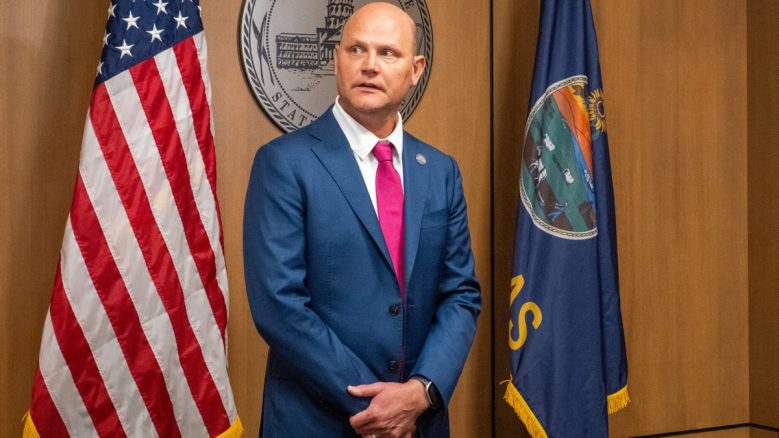
 Molly Adams / Lawrence Times

Latest Lawrence news:
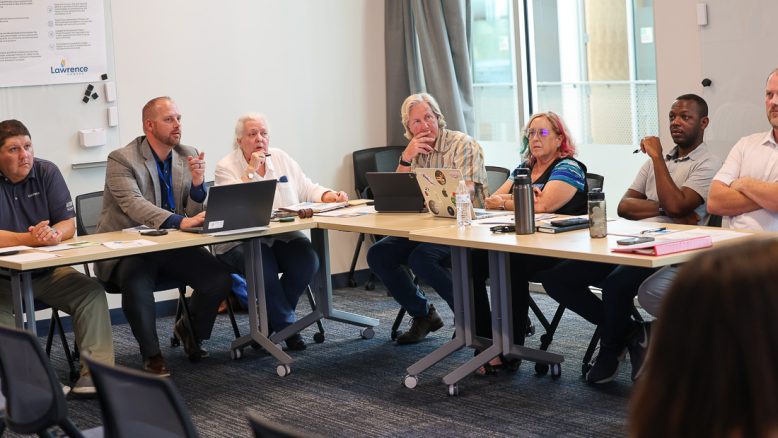 Wulfe Wulfemeyer/Lawrence Times
 Jacob Rice / Lawrence Times