
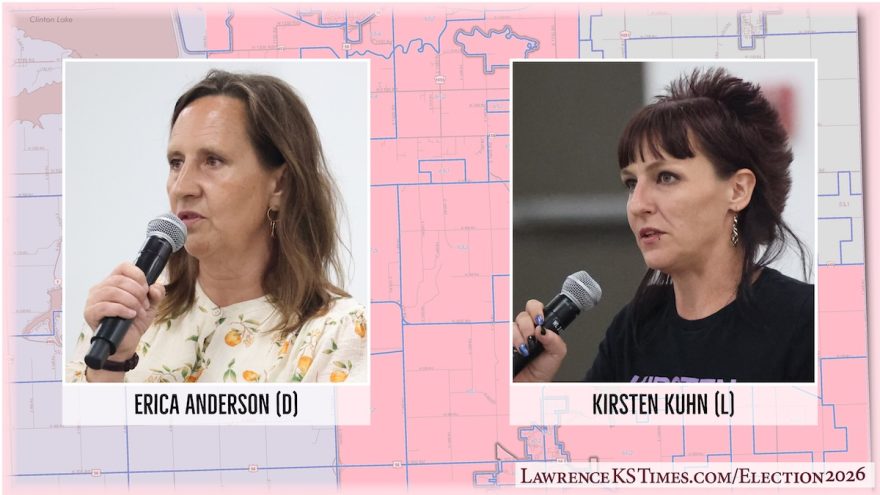
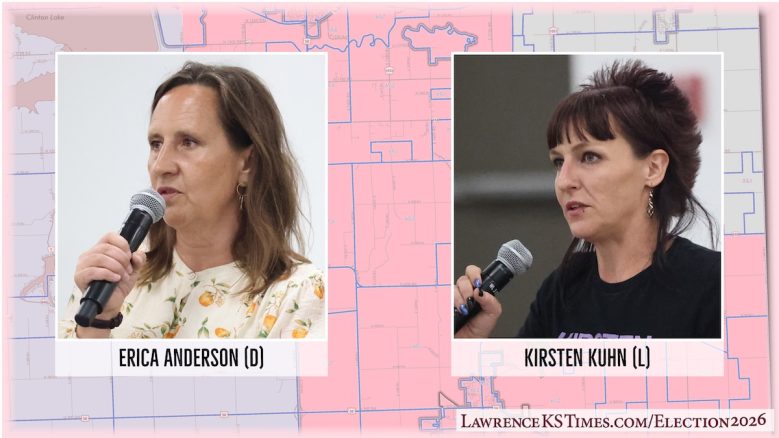
A Democrat and a Libertarian are running to represent Baldwin City, parts of south-central Lawrence and much of southeastern Douglas County as the commissioner for District 5.
Democrat Erica Anderson (incumbent) and Libertarian Kirsten Kuhn will face off in the Nov. 3 general election. This race will not appear on voters’ Aug. 4 primary ballots, but we wanted to get their answers out at the same time as the other candidates’ and will republish this closer to the November election.
We asked candidates about the top issues driving them to run, whether the county should implement a moratorium on data centers and more.
We did not give candidates a word count limit but advised them to keep answers concise. Candidates’ answers appear below verbatim, minus minor typos edited for clarity.
Will this race be on my ballot? Check which Douglas County Commission district you’re in at myvoteinfo.voteks.org.
All registered Kansas voters are eligible to vote in the primary election because there’s a constitutional amendment on the ballot. Early voting in the primary election begins Wednesday, July 15. Voters can request a ballot to vote early by mail through Tuesday, July 28 at KSVotes.org. Polls are open from 7 a.m. to 7 p.m. on Election Day, which is Tuesday, Aug. 4.
Find out more at lawrencekstimes.com/election2026.
Jump to a topic:
• Meet the candidates
• Experience and qualifications
• Top 3 issues
• Property taxes
• Data centers
• Tenant eviction defense
• Nonprofit partners
• Commission expansion, dynamics
• Other issues
• Question for your opponent
• Free space
• Just for fun
Don’t miss a beat … Click here to sign up for our email newsletters
Click here to learn more about our newsletters first
This district
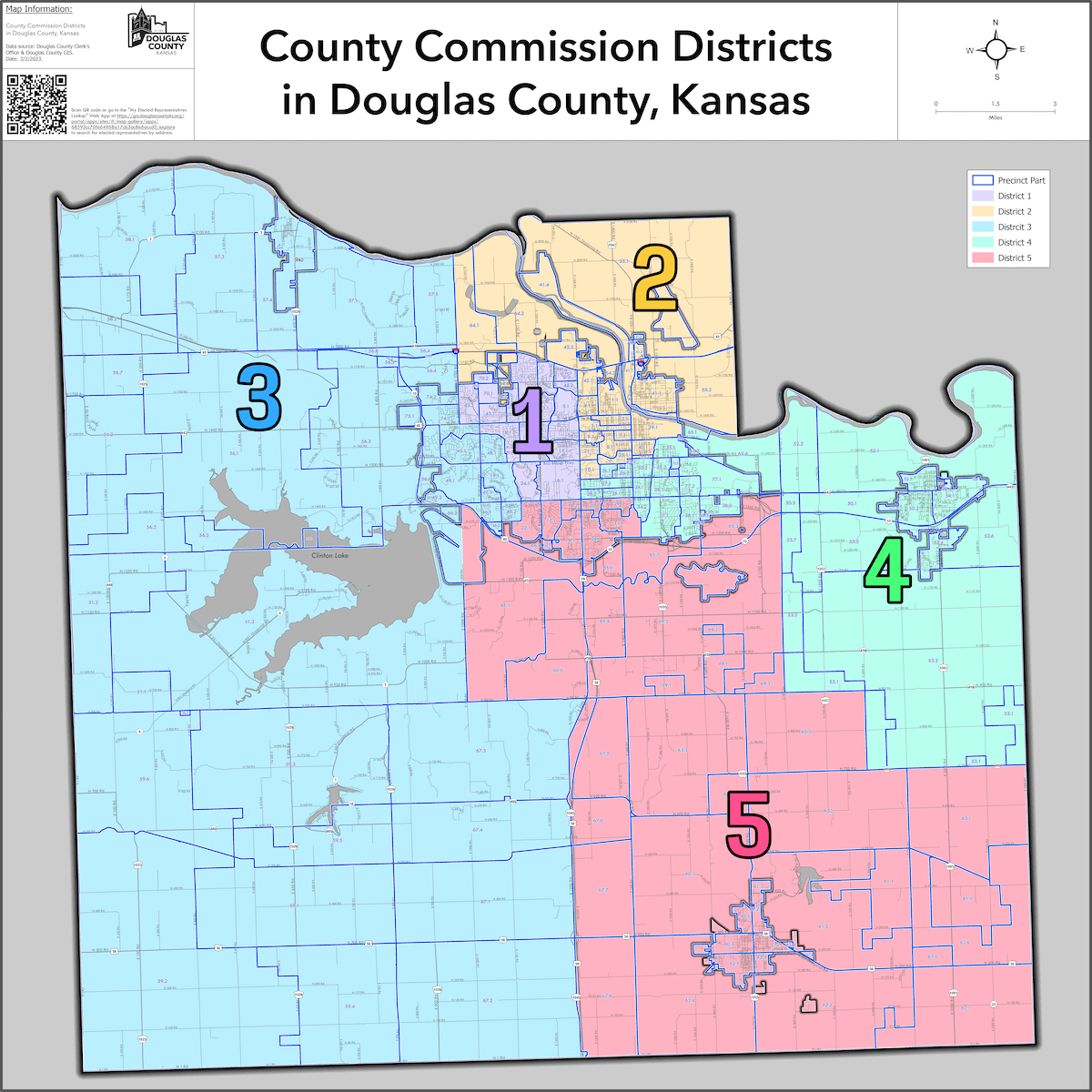
Douglas County Commission District 5, highlighted in pink in the map here, includes a portion of south-central Lawrence, reaching as far north as Clinton Parkway. It spans south and east to the county lines in some areas and includes Baldwin City.
Its northernmost boundary reaches Clinton Parkway from Crossgate Drive to the west to Vermont Street to the east. Its westernmost boundary north of North 900 Road is East 1000 Road, and then it includes much of the county east of East 1296 Road and East 1250 Road, including U.S. 59 Highway.
Its boundaries span to the eastern county line from the southern county line north to North 700 road, then follows East 2000 Road to North 900 Road and goes north to East 23rd Street to include a portion of far eastern Lawrence near the Kansas Highway 10 and East 23rd Street interchange.
See a zoomable PDF map at this link.
Meet the candidates

Erica Anderson, PhD
Running as: Democrat
Pronouns: (no response)
Hometown, and time in Douglas County: Lived here since 1983
Where you currently reside: Baldwin City, Palmyra Township, Unincorporated Area
Day job: Quality Lead, Kaiser Permanente
How voters can reach you: 785-766-6809 / [email protected]
Campaign website, social media links: erica-anderson.com
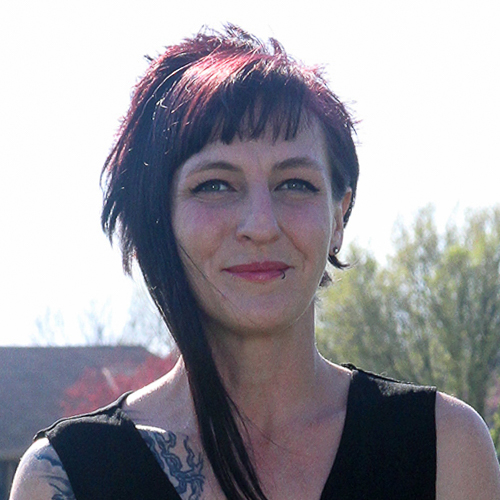
Kirsten Kuhn
Running as: Libertarian
Pronouns: (no response)
Hometown, and time in Douglas County: My father was military, so I’ve lived all over the place but my family is largely located in Wisconsin. I moved here to attend KU in late 2011. Although I’m not originally from here, Douglas County is now my home.
Where you currently reside: I’ve lived out in rural Palmyra Township since 2019. Prior to that, I was in Lawrence
Day job: Because I’ve been focused on civic engagement and government oversight, I pay my bills via gig work so that my schedule is flexible. Although I don’t get paid for it, I consider my work serving on the Bert Nash Board, running my nonprofit, and monitoring local government activities to be my day job. Because I work in the gig economy, I can promise you that I can and will dedicate 100% of my time to this position. I will not have any other priorities that would interfere with me serving you. I promise to have regular office hours once a week (alternating Baldwin City and Lawrence) so that you never have to worry about emails missing me, phone calls dropping, or any other shenanigans. You can simply come and meet me in person to discuss your concerns.
How voters can reach you: [email protected]
Campaign website, social media links: Kirsten4five.com; Kirsten4Five on Facebook, Instagram and Twitter
About you and your positions
Q: What specific experience and qualifications do you possess that make you the best candidate for the seat you seek?
Anderson (D): As the incumbent, my professional background in health-in-all-policies and social determinants of health shapes how I approach this seat: reviewing community partner funding requests, evaluating land use, infrastructure, and food systems decisions with real whole health consequences, and asking whether county funded programs are producing outcomes, not just existing. As a first-generation college graduate, someone with aging-in-place parents, I see firsthand how tax dollars sustain, or fail to sustain, the services families depend on. Before a vote, I do the homework, reading agenda materials, budget lines and code directly, looking at how a decision developed over time, and talking with the people affected. When taxpayer money is spent, I believe we owe residents proof it’s working, and the willingness to say so publicly when it isn’t and be willing to rethink our future.
Kuhn (L): What sets me apart is that I know you can run your life better than I, or any other elected official, can. I will not view your tax dollars as my money, to be allocated to whatever whim. I’m bringing a healthy sense of skepticism and critique to the affairs of the Douglas County Commission, which rarely seems to find a project that they aren’t willing to fling tax dollars at. They’ve
been voting into an aspiration, not voting based on reality. Our residents are struggling to be able to remain in the community
and we need to get a handle on expenditures. Some people may not like it, but the fact is that resources are finite. Sky-high home valuations don’t put food on the table, and sky-high property taxes actively take food off. I’ve never made much money, so I understand what it takes to get by. I’m not sure how true that is of the rest of the Commission.
Q: Please list the top 3 issues motivating you to run for this office. What concrete ideas do you have to make a difference on each issue if you are elected?
Anderson (D):
1. Funding accountability. I’m running to finish work already underway: to continue to call for stronger rubric-based scoring for community partner funding, so decisions rest on documented outcomes and funding need rather than renewal by habit. Several of the projects we fund overlap with the City of Lawrence, including A Place for Everyone, and through the Familiar Faces initiative. I’d like to bring this framework forward as a joint review with the City Commission, so both bodies can look together at whether these shared investments are producing real outcomes, not just ongoing activity.
2. Taxpayer burden and the ability to age in place. These are connected: property tax pressure is one of the biggest threats to people staying in their homes and communities as they age. I’ll keep working to identify where the county can reduce costs, advocate and drive economic mobility without selling out the food systems and open space that make Douglas County the reason we want to continue to live here.
3. Representing Douglas County/District 5. I’ll continue doing the job the way I have: answering every call and email, showing up at community events across Douglas County and listening, learning, and doing my homework to inform every vote. I will continue to serve on committees such as the Criminal Justice Coordinating Council and the Community Health Improvement Plan.
Kuhn (L):
The County Commissioners need to take back their power. There has been a trend whereby staff makes recommendations and the Board simply capitulates. A great example of this was the recent Truancy Pilot Program. A well-regarded community partner brought a proposal to staff, which staff did not deign to share with Commissioners, as it was determined to be “not good.” It is not the role of staff to determine such things. Then the BOCC adopted the staff proposal for the county to fund it at a higher rate than the partner’s proposal, on the basis of “a lot of staff time” having been put into it. Staff time should not be the determining factor of whether to stand up an entirely new program on your dime.
Of course property taxes are an enormous concern, and one that I’m glad to finally hear from the incumbent commissioners. But it isn’t the case that this just occurred overnight. It has been the prolonged tax-and-spend policies of the primarily Democrat commission. We cannot fix this problem by continuing with the same solutions we’ve had. We can lower property taxes by reducing our expenditures. There is no reason that Commissioners and county staff should be making as much as they do. The past several years the county has given raises well above market and it’s simply untenable. The County also needs to focus on its core services, and discourage such heavy reliance by community partners on taxpayers.
I’d also like to focus on the needs of our rural residents. While it is true that Lawrence is a large and important city in the county, it cannot and should not forced residents of the other cities or incorporated areas to fund its own aims. Just because it has more people does not mean that those who don’t live there don’t matter. Many people do not live in Lawrence due to the city’s policies and others cannot live there due to its policies. The Commission needs a voice for those people.
Q: Many Douglas County residents have voiced concerns about property taxes increasing over the last several years.
Do you believe that property taxes can be reduced from current rates? If yes, how would you reduce them, and if no, why not?
Anderson (D): Yes, but it will take time as county property taxes are only part of the equation. Your tax bill reflects several taxing jurisdictions, the county, cities, school districts, and others, yet the county often gets held accountable for the whole. Real reduction requires looking at the entire picture: bringing the taxing jurisdictions together to evaluate who is funding what, and honestly asking who should be funding what.
Within the county’s own budget, my record shows I’m willing to make the hard calls: I’ve voted to say no to projects that were fiscally unsound and lacking policy oversight, cut positions that weren’t reducing the problems they were created to address, and to pause funding where transparency was lacking. At the same time, I’ve supported funding for community organizations that demonstrate real outcomes, and voted to defund those that couldn’t show outcomes or data. That’s the standard: taxpayer dollars go where they demonstrably work and stabilize our community.
But lasting relief has to be a collective effort. When the state keeps tying local hands, cutting local revenue, handing out incentives that benefit the few, and leaving utility ratepayers exposed it falls to the local level to advocate for ourselves, rethink how our system works, and create the outcomes we want for our future.
Kuhn (L): Yes. As previously mentioned, focusing on core services such as public safety, fire/medical, and our other major infrastructure is where the Douglas County Commission should spend its time. High property taxes punish people for improving their homes, squeeze retirees and others on fixed incomes, and can force families out of homes. We do have some great community organizations doing amazing work, but it simply is not within the capacity of the County to fund them all.
If resources like this are helpful to you, please support The Lawrence Times.
Click here to subscribe.
Q: An issue that has gained a lot of attention recently is the potential for large-scale data centers to be developed in Lawrence and/or Douglas County.
Do you believe the county should establish a firm moratorium on data centers? What should voters know about your stance on data centers?
Anderson (D): Yes. I called for a moratorium on data centers at the BOCC work session, and I called for our county counsel to review our legal options so the commission can take the next step with a firm legal footing. A formally adopted moratorium gives the county the time and standing to finish its zoning review and decide what belongs here based on our infrastructure, rather than reacting to whatever proposal arrives first.
Kuhn (L): Yes. While I generally support the right of owners to do with their property as they will, the impacts of hyperscale data centers are not regularly constrained to simply the owner’s property. There are any number of environmental concerns, including light and noise pollution, and it is my view that some of the current projects moving forward are likely not viable. There are increased infrastructure demands that I do not believe the county is capable of handling, at least without spending an unwarranted amount of money. Additionally, these projects often request, and are granted, tax abatements which negates the initial desirability of these projects as tax generators.
Q: The commission in May approved a pilot program for two nonprofits to provide tenant eviction defense services at a cost of $40,000. Housing advocates had pushed for a larger tenant right to counsel program.
Note: It is too early to have data about the program’s performance — this question is only asking about the pilot program as approved.
• Incumbents, what was your vote on this program, and why? Newcomers, how would you have voted, and why?
• All candidates, please explain your view of the program as approved. Do you feel that it is doing enough? Doing too much?
Anderson (D): I voted no because funding legal defense downstream, while the upstream accountability questions go unaddressed, asks county taxpayers to pay for the symptoms of a system nobody is fixing.
As for the program as approved: now that it exists, my focus is on clear outcome measures, honest reporting, and transparency. If the pilot demonstrates real results, that evidence should drive the next decision. If it doesn’t, we should say so plainly rather than renewing by default. Unfortunately, staff have already placed this program in the proposed county budget, double the pilot amount, before any outcomes have come in and before the commission has weighed in on whether to continue the work at all. That’s backwards and lacks common sense. Evidence should drive the next decision, not budget momentum. If the pilot demonstrates results, let the data make that case. If it doesn’t, we should say so plainly rather than renewing by default.
Kuhn (L): I would have voted no. There are organizations in the community that do this work already. Furthermore, it is not the purview of government to provide legal services, except when that government itself is bringing criminal charges. Evictions are civil matters and as such should not be funded by taxpayers (unless they voluntarily choose to do so in their individual capacities).
Q: The county provides funds for many nonprofit partners that aim to address certain issues across the community. Please explain whether you believe the commission currently has enough oversight and accountability for how those funds are spent, and whether you would like to see any changes made to the way things have been done in the past.
Anderson (D): No, I don’t believe our current oversight is enough and this is where I’ve put much of my energy this term. This budget cycle, I reviewed every community partner request line by line, more than 40 organizations. What I found confirms the need for change: funding decisions have historically run on renewal by habit rather than demonstrated outcomes. We can point to a lot of activity, but too often we can’t point to results and in some cases we can’t even get consistent data. There are also structural patterns worth attention: funding concentrated heavily in one part of the county while other communities receive little or nothing, organizations that have become almost entirely dependent on county dollars, and programs appearing in the budget before the commission has actually decided to continue them.
The changes I want are straightforward. First, a rubric-based scoring framework applied the same way to every partner measuring outcomes, need, fiscal health, and geographic equity so decisions are consistent and defensible. Second, outcome reporting as a condition of funding, not a courtesy. Third, regular meetings with our shared-cost partners; right now, that means the City of Commission sitting down together so we can align on what we jointly fund and the outcomes we actually want from our joint commissions and plans, rather than each body funding pieces in isolation. And finally, honesty in both directions: organizations that demonstrate results should be funded confidently, and I’ve supported them; organizations that can’t show outcomes or data shouldn’t be renewed simply because they were funded last year. Taxpayers deserve to know their dollars are going where they demonstrably work and are staying in Douglas County serving Douglas County.
Kuhn (L): The County has a role in oversight to the extent that it is funding these organizations. The larger question is whether we should be funding as many organizations as we do. This is not to say that I do not support these endeavors for what they accomplish, simply that the County must be constrained not only by their revenues but also by their proper role – to secure the rights of their citizens. My nonprofit has never sought, nor received, any governmental funds. Other organizations should do likewise. Further, we would individually have more money to support our preferred causes if we weren’t paying so much to the government. When they take $1 in taxes, they spend the majority of that on layers of bureaucracy. What if you could just give that whole dollar instead?
Q: Since the commission expanded to five seats and two additional perspectives joined the mix, regular meeting attendees have observed changes in the dynamic of meetings. What thoughts do you have about how the commission and its meetings have changed?
Anderson (D): Yes, meetings have changed and I’ve contributed to that change. I ask hard questions, and I’ve been told I ask questions that have never been asked before on this commission. I take that as evidence the questions were overdue. When public money and land, resources, are on the table, someone should be pulling items off the consent agenda, asking staff to explain their work on the record, and requesting the full scope behind a recommendation before voting on it.
Five seats means five perspectives, and that’s exactly what expansion was supposed to deliver. The result is meetings that run longer and debates that are more substantive less unanimity for its own sake, more genuine deliberation in public view where it belongs. I understand that can feel less comfortable than the old rhythm. But comfort was never the measure of good governance. Constituents deserve a commission where discourse and disagreement happens openly, questions get asked and every vote comes with reasoning you can hear for yourself.
Kuhn (L): I agree that the dynamics have changed, in that there is more disagreement amongst Commissioners than previously. However, I have not seen this translate to a change in actual voting outcomes. There seems to be a split between the 3 original incumbents and the two new ones.
Optional questions
Q: What county issue or issues that we have not asked about here do you believe voters should pay close attention to during this election, and why? Explain your stance on the issue(s)?
Anderson (D): Vote No. Voters should pay close attention to the constitutional amendment on the August 4 ballot, which would replace Kansas’s merit-based selection of Supreme Court justices with direct partisan elections. Moving to direct elections would invite money and partisan pressure into courtrooms that decide issues affecting every Douglas County and Kansan families, from school funding to property rights. Judges should answer to the constitution, not to donors. The current system isn’t perfect, but it has served Kansas well, and we should keep it.
Kuhn (L): We need to be concerned about the ever-growing surveillance apparatus.
Q: Please share a question we didn’t ask that you’d like your fellow candidates to answer. How would you respond?
Anderson (D): (no response)
Kuhn (L): (no response)
Q: Free space: Please share anything you’d like voters to know about you and your stances that we haven’t asked here.
Anderson (D): (no response)
Kuhn (L): I’ll take a moment to perhaps assuage some concerns you may have about Libertarians. We are often accused of not wanting to do things at all, simply because we know the least efficient way to have anything done is to have the government do it. Money is wasted on layers of bureaucracy, and often the most important voice is disregarded – yours! The County’s budget has doubled since 2019. Are you getting double the value? Or is it double the burden? Voting for one-party rule is how we got into this mess. It’s not how we’re going to get out. If you want change in DGCO, you have to vote for it.
Just for fun
Candidates were not required to answer any of these questions, but we wanted to give our readers a chance to get to know them a little better and have some fun with this.
Anderson (D):
Favorite color? Orange
Zodiac sign? Sagittarius
Do you have any pets, and/or what’s your favorite animal? Moose
Favorite book, TV show and/or movie? Long Shot
What’s a fun fact our readers may not know about you? (Have a hidden talent? Interesting hobby?) Trail running
Kuhn (L):
Favorite color? Black, followed by purple
Zodiac sign? Taurus
Do you have any pets, and/or what’s your favorite animal? We have ferrets and cats in the house. Our little homestead has chickens, ducks, bees, and a turkey.
Favorite book, TV show and/or movie? My all-time favorite movie is Con-Air, but of course it’s hard to choose.
What’s a fun fact our readers may not know about you? (Have a hidden talent? Interesting hobby?) I know the entirety of Edgar Allen Poe’s The Raven.
If local news matters to you, please help us keep doing this work.
Don’t miss a beat — get the latest news from the Times delivered to your inbox:
Click here to learn more about our newsletters first

This post is by the Lawrence Times news team.
If you have news tips, questions, comments, concerns, compliments or corrections for our team, please reach out and let us know what’s on your mind. Email us at [email protected] (don’t forget the KS!), or find more contact info and a quick contact form at LawrenceKSTimes.com/contact.
Follow us so you won’t miss the local news that matters most to you:
More coverage: Election 2026
 Molly Adams / Lawrence Times
 Molly Adams/Lawrence Times
 August Rudisell/Lawrence Times
Latest Lawrence news:
Molly Adams / Lawrence Times
Molly Adams/Lawrence Times
August Rudisell/Lawrence Times