

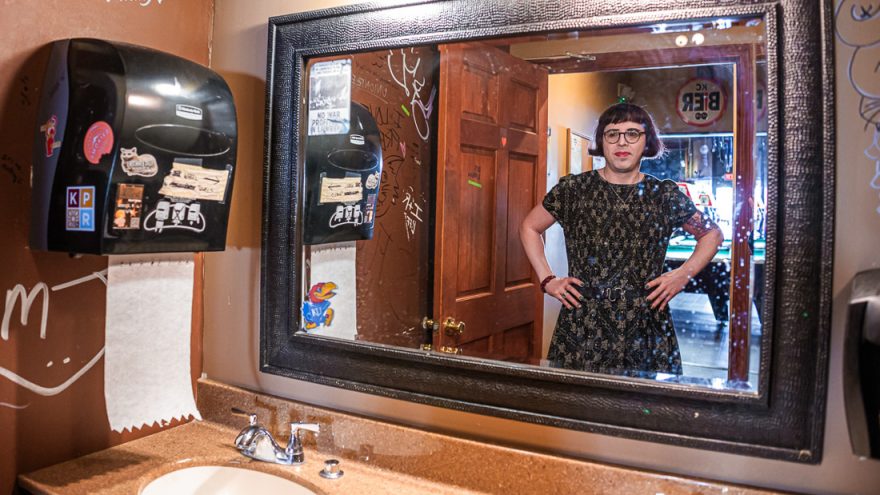
Staff at the University of Kansas are starting to enforce an anti-transgender bathroom bill.
Siobhán Kirchstein spent Friday evening at Harbor Lights unwinding with friends. She got off work early that day after she received an email from Katie Varner, director of employee relations at the University of Kansas, informing her that she had been reported for using the women’s bathroom in Parker Hall.
Kirchstein is a transgender woman who works as a janitor at the university’s Kansas Geological Survey.
“My immediate reaction was complete shock that anyone in the Kansas Geological Survey would do that to me in the first place,” Kirchstein said. “And then I was furious about it.”
She has been using the women’s bathroom at KU for years. But in February, Kansas legislators pushed Senate Bill 244 through using “gut and go” tactics.
Don’t miss a beat … Click here to sign up for our email newsletters
Click here to learn more about our newsletters first
The bill forces trans people to use multi-occupancy bathrooms that align with their sex assigned at birth as opposed to their gender identity in public buildings like KU. It also bars people from changing their gender markers on their state-issued documents, like driver’s licenses, while reverting any changes that have been made in the past.
“I am reaching out to you from Human Resources in response to a report received that I have an obligation to follow up on,” Varner wrote in the Friday email to Kirchstein. “I wish to preface this email by acknowledging this is a sensitive matter and my intention in reaching out is to provide awareness of the report and the law, extend to you an opportunity to be heard, and if helpful, share resources.”
Please support
The Lawrence Times!
Subscribe here.
If an institution receives a complaint about a person’s bathroom usage, the law requires them to send that person a notice with the date and location of their bathroom use, a note about fines that accompany repeated complaints, and “the procedure to administratively appeal the finding,” per the language of SB 244.
Varner followed these three steps in the email. She did not specify if the university is currently facing a fine.
If a public institution is reported to the Kansas Attorney General because someone uses a multi-occupancy bathroom that does not align with their sex assigned at birth, the institution can be fined $25,000 for the first violation and $125,000 for each subsequent day or additional violation.
Folks who are reported for using what the bill deems the “wrong” bathroom can be fined $1,000 after the second violation under SB 244. After that, it’s a misdemeanor.
Kirchstein said she hasn’t heard of any other people around Lawrence or Kansas being reported for bathroom use, nor had she heard of public buildings actively enforcing SB 244. She pointed to transgender activist Samantha Boucher’s act of civil disobedience in March. Boucher tried, to no avail, to get arrested by using the women’s bathroom at the Kansas Statehouse.
Since an interview in March, Kirchstein has had a refrain: it only takes one person.
“It does not matter whether or not KU says they’re not going to enforce SB 244 because all it takes is one person to freak out in the bathroom and report me, and that is exactly what happened,” she said on Friday.
KU’s enforcement
“The report received was that you used a restroom in Parker Hall on the first floor in violation of Kansas Senate Bill 244 on June 22, 2026,” Varner wrote to Kirchstein.
Almost three weeks passed between the date that Kirchstein allegedly used the bathroom and Varner’s email to her. The email does not specify when KU HR received the complaint.
Varner and KU spokesperson Erinn Barcomb-Peterson did not respond to questions for this article, including when they received the report and how they verified that Kirchstein used the bathroom in question that day. They also declined to answer if and how they verified Kirchstein’s sex assigned at birth versus her gender identity before emailing her.
“As you likely know, we can’t comment on an individual’s personnel matters,” Barcomb-Peterson said via email. “That being said, the university has an obligation to comply with state law.”
Varner and Barcomb-Peterson did not respond to initial questions or a follow-up email asking again if KU has a written policy for handling reports under SB 244, and what that policy entails.
In her email, Varner points Kirchstein to KU’s Employee Assistance Program and the director of Mental Health and Wellbeing, who also works for KU HR. Varner also encouraged Kirchstein to respond to the report via email or during an in-person meeting, but the ultimate directive is clear.
“Regardless, please ensure you are adhering to SB 244,” Varner wrote.
She also wrote that Kirchstein could request “a different work area where there are all-gender, single-use restrooms.”
“Why should I move myself to a building just so I can use a bathroom that would make other people more comfortable?” Kirchstein asked. “I’m just going to keep using the bathrooms that make me comfortable because I’m a human being. I have dignity, and telling me that I can’t use a particular bathroom because it makes other people uncomfortable, that takes away from that.”
Following Varner’s email, Kirchstein reached out to advocacy organizations for support. Kirchstein said she doesn’t plan to respond to Varner’s email at this time.
Kirchstein’s response
“I’ll stay until they basically fire me,” Kirchstein said. “If that’s what they want to do, that’s what I’ll do. But I have no intention of complying. No intention at all.”
She said she knew her employment status could be at risk in speaking with the press.
Kirchstein has a constitutional right to speak to the press about her experience, but she pointed to Anthony Alvarez.
Alvarez, a trans KU graduate, was fired from his job at Grace Pearson Scholarship Hall shortly after speaking to news outlets about the hall’s ban on gender-inclusive housing. He initially sued the university and his supervisors, although KU was dropped from the lawsuit last year. A federal judge recently retained one complaint on the case, meaning Alvarez can argue that his supervisors violated his First Amendment-protected speech.
“I’m not the first person that they would have fired for trying to take on HR because HR does not serve employees,” Kirchstein said. “They serve the administration.”
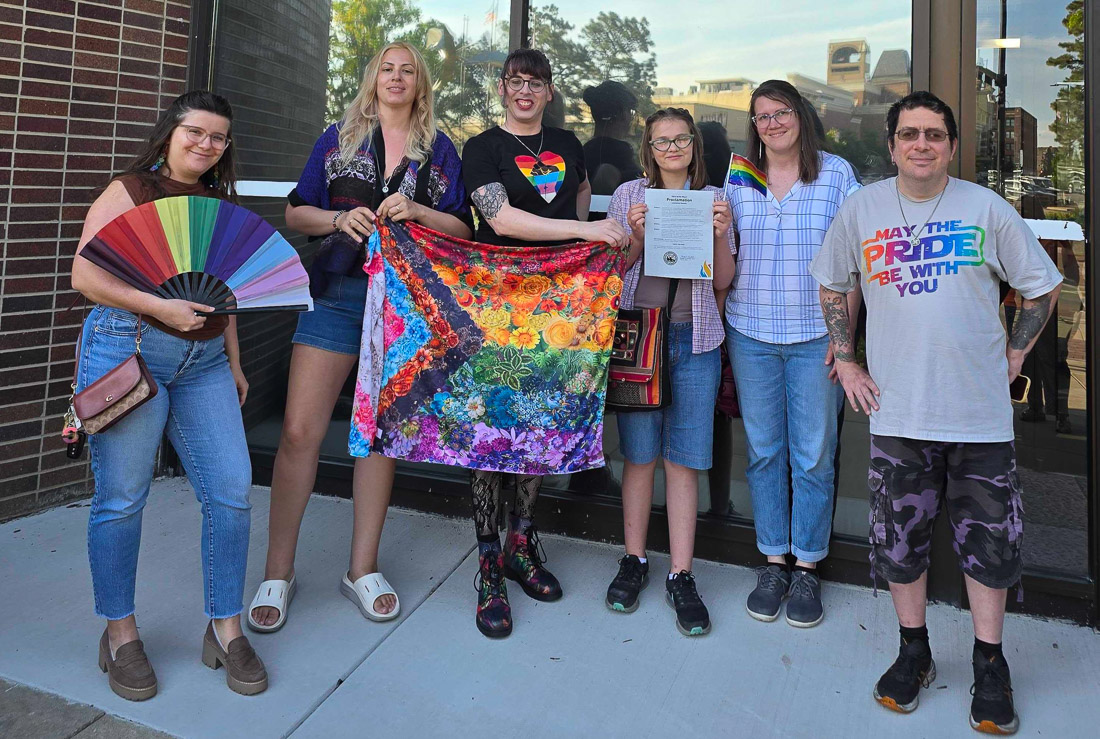
Kirchstein wants people to recognize SB 244 for what it is: legal segregation.
“It is a legal form of making trans people second-class citizens,” she said.
She said if Lawrence community members are behind trans and queer people, they should push against the law by speaking up to the city commission, their legislators, KU administration and the university’s donors.
She hopes to see SB 244 stricken down. In the meantime, Kirchstein plans to fight for her rights and to preserve her life in Lawrence. She has exciting developments in her personal world, and she’s proud to be the secretary of Lawrence PRIDE.


“I remain positive because regardless of what they do, this community right here in Lawrence is amazing because we show up. And we show up in these safe places with joy and vibrancy. We can be exactly who we want to be, and we’re accepted for exactly who we want to be, and we stand up for each other because we believe in mutual aid, which is beautiful.”
Should she lose her job, she said that wouldn’t push her from Lawrence.
“I’ll stay right here,” Kirchstein said. “I’ll stay right here.”
If local news matters to you, please help us keep doing this work.
Don’t miss a beat — get the latest news from the Times delivered to your inbox:
Click here to learn more about our newsletters first

Wulfe Wulfemeyer (they/them), reporter and news editor, has worked with The Lawrence Times since May 2025. They can be reached at [email protected].
Read their complete bio here. Read their work for the Times here.
More coverage:

 Jacob Rice / Lawrence Times
Latest Lawrence news:
 Cuyler Dunn/Lawrence Times

 Nathan Kramer / Lawrence Times