
Lawrence’s transit director says if voters don’t approve a sales tax increase, the number of city-maintained bus routes and paratransit availability will shrink drastically.
Lawrence Transit has been part of the city’s transportation network for 25 years. Felice Lavergne, the director, said city staff is asking for an increase and extension to an existing transit sales tax in order to maintain that system.
The city operates 11 fixed bus routes from 6 a.m. to 8 p.m. Monday through Saturday. People can schedule on-demand rides for $3 each way during all off hours on weekdays and weekends. Lawrence Transit also operates a T Lift Paratransit service, which is a door-to-door ride service for people with disabilities.
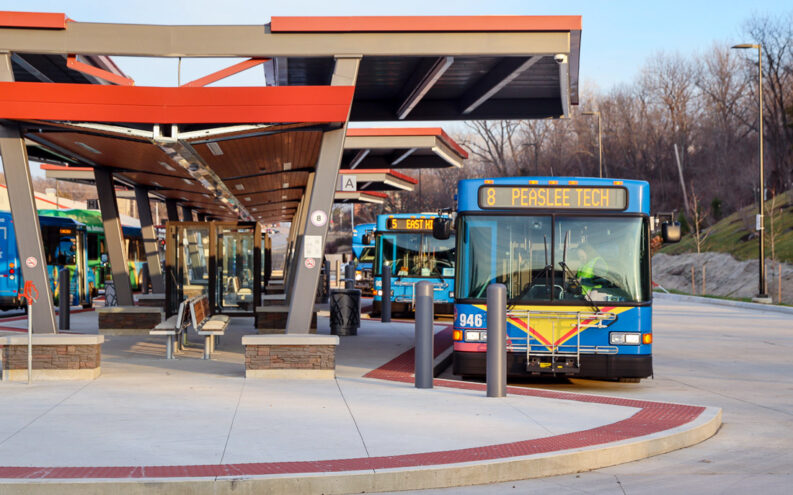
Its Central Transit Station, 2315 Bob Billings Parkway, is open for the hours at this link on Sundays through Fridays. The station has a lobby area with seating, bike racks, a boba cafe run by Boba & Beyond, a free naloxone vending machine and a pay-what-you-can bookstore from the Library Friends & Foundation.
Don’t miss a beat … Click here to sign up for our email newsletters
Click here to learn more about our newsletters first
The city is in the process of building a downtown station, which is currently in a federal environmental review process.
Lawrence residents will vote on the sales tax rate proposal on their Nov. 3 ballots. Early voting began Wednesday. Here’s your guide to what the proposal means, and what Lawrence’s transit system might look like if voters aren’t in favor.
Jump to a question:
• What is the sales tax proposal, and how much would it cost me?
• If we don’t approve the proposal, will the transit sales tax go away completely?
• How is Lawrence Transit currently funded? And how does KU affect those numbers?
• Why is the city proposing an increase and extension to the transit sales tax?
• What does that sales tax money go toward specifically?
• Why not fund transit with fares?
• Are there any other options? What has Lawrence Transit done to save money?
• What does the city say will happen if the sales tax isn’t approved?
• When is the election?
What is the sales tax proposal, and how much would it cost me?
Lawrence voters approved a 0.25% sales tax to fund transit for 10 years starting in 2008. Voters again approved a 0.2% starting in 2018 for a 10-year period.
Please support
The Lawrence Times!
Subscribe here.
The city currently has an overall sales tax of 1.60 cents per dollar. One cent goes to general city operations, 0.1 cents are for affordable housing, 0.3 cents go to streets and infrastructure projects and 0.2 cents are for transit.
At the current 0.2% transit sales tax tax rate, people pay 4 cents on every $20 they spend, or 20 cents per $100 spent, for transit funding.
Transit staff are proposing increasing that rate to 0.3%. That would mean people pay 6 cents on every $20 they spend for transit funding, or 30 cents per $100 spent.
The active 0.2% sales tax rate is set to expire March 31, 2029. If voters opt for this new proposal, the 0.3% rate would go into effect April 1, 2027 and last through March 31, 2037.
Here’s the exact question you’ll see on your ballot.
If we don’t approve the proposal, will the transit sales tax go away completely?
If voters do not approve the increased and extended transit sales tax, the 0.2% sales tax rate would persist through March 31, 2029.
Lavergne said there would be time to add a ballot question in 2027 proposing another 10-year extension of the 0.2% rate.
How is Lawrence Transit currently funded, and how does KU affect those numbers?
“The city and KU each fund our separate transit systems, but we act as one system. We collaborate,” Lavergne said.
Lawrence Transit and KU Transportation Services put out a shared transit guide each year, and anybody can ride any bus from either system. They also negotiate contracts with the service provider — the company that hires the drivers and handles what happens on routes — together.

Lavergne said Lawrence Transit benefits from the partnership because they can count total rider numbers on both systems when they apply for federal funding.
“We do 7,000 rides a day, and that’s our combined system, all services,” she said.
Lawrence Transit is federally classified as a small urban system that gets operating funding from the federal government, but thanks to those high user numbers, it qualifies for the federal State Transportation Innovation Councils Incentive Program.
“It’s funding for small urban systems specifically that have higher ridership than expected, and that’s usually around university towns,” Lavergne said.
But that’s just one cog in the full transit funding machine.
“It’s a combination of ridership, population, and some other things at the federal and state level that drives how much funding we get,” she said.
More riders equals more federal funding, per Lavergne. Greater sales tax also equals greater funding, as the federal government does a 50-50 match based on the money Lawrence Transit brings in. For example, if transit makes $1 million in a year through sales tax, that’s the cap for federal funding in a year.
Federal funding for transit in 2026, directly influenced by sales tax revenue and ridership, came out to $4.2 million. State funding was $1.2 million, meaning a $5.4 million total.
Why is the city proposing an increase and extension to the transit sales tax?
Lavergne has worked at Lawrence Transit since 2021. When she stepped into the role of director in May 2025, she and her team made a 10-year forecast for the department, and she felt this solution offered the best long-term stability.
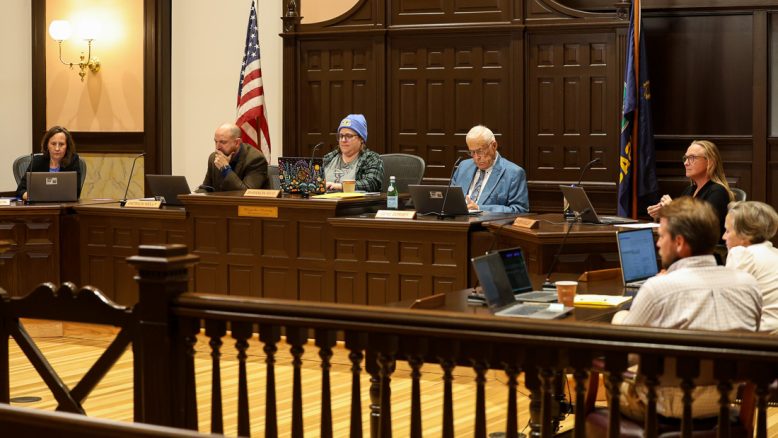
As she told the city commission during a May meeting, the forecast takes into account an increase in contract costs with service providers come 2029, which includes downtown station operating costs and funds for part-time staff. Lavergne said they have enough funding to build the downtown station, supplemented by federal money, but staffing and operational costs are not included in the budget.
The forecast also projects a dip in 2029 federal funding. Lavergne said there will be a new infrastructure and transportation bill that year.
“The current bill, the IIJA, included historically high levels of transit funding and industry experts don’t expect the next bill to include as much funding for transit, although amounts are unknown,” she said.
Lawrence Transit’s expenditures went $650,000 over its revenue in 2024 and $1.1 million over in 2025. Staff expects transit to have $41,000 in revenue in 2026.
However, the deficit would likely widen in the coming years under the current sales tax model. The forecast suggests Lawrence Transit would need to overspend $2.9 million in 2030, completely drying up reserve funds.
Lavergne told the commission they would probably need to cease transit operations at that point.
She presented a second forecast showing expenditures and revenues given a 0.3% sales tax rate, which shows transit longevity through 2033, although expenditures would be dipping into the reserve fund balance.
Lavergne told the commission that the projected deficit starting in 2030 “could be managed with fares, additional revenue streams or service cuts, a 0.3 sales tax and negotiating a more favorable (service provider) contract in 2029.”
On Wednesday, Lavergne said bus transit costs have increased 75% nationwide since 2014. State and federal funding structures haven’t kept pace.
“Local costs rose sharply along national trends,” she told the commission in May. “Federal funding adjustments move slowly. Sales tax has been outpaced by expense inflation.”
What does that sales tax money go toward specifically?
Lavergne said the greatest cost comes from service hours maintaining the bus routes, paid to the provider Transdev. Much of the tax also goes to buses and maintaining assets around town, including 400 bus stops.
Plus, about $406,000 of the $2.03 million budgeted for the downtown station project will come from sales tax money.
“We have grant funding to build it,” Lavergne said. “… Knowing if we do or don’t have the sales tax will influence what we build and how we operate it.”
If resources like this are helpful to you, please support The Lawrence Times.
Click here to subscribe.
Why not fund transit with fares?
“If fares could solve this conversation, I wouldn’t be asking for a sales tax in this way, at this time, at this amount,” Lavergne said.
She said that if they used fares as their only federal matching fund, the transit system would be significantly smaller.
“If the most fares we ever collected was $400,000, that’s the amount of federal funding we could bring down,” she said.
She said larger cities might use fares to fund their transit system, but Lawrence has historically brought in low fare revenue and the numbers don’t crunch out.
“We’d have to pay to print the tickets, pay to deliver the tickets, pay for the armored trucks for the security of the fares,” she said. “So there’s a lot of revenue loss there in general.”
“I think we are funding transit the right way in Lawrence,” she added.
Lawrence Transit went fare-free in 2023 after the city commission approved the proposal in August 2022. Staff reevaluates the fare-free structure annually.
At the time, Lawrence Transit found that fares covered 6% of operating costs before 2020, and 3% in 2020 and 2021. (COVID-19 affected ridership and fares in those latter years.)
However, they can make a difference for riders.
“Fare free has a greater impact on people in our community who have less income. Eliminating bus fare can make a tangible difference for many riders,” a city webpage reads.
Whether or not fares would return is up to the city commission through a “robust public process,” according to Lavergne.
What has Lawrence Transit done to save money?
Here’s what Lavergne says she and her team have done to cut costs since she became director:
• She said they’ve cut back on any possible overages in their contract with Transdev. For example, when routes were seeing lower usage from 8 to 8:30 p.m., they cut service back to end at 8 p.m. They also changed on demand hours and reintroduced a $3 fare for a one-way ride in March.
• Lavergne has delayed bus purchases for the city’s aging fleet. Instead of using all local money to buy buses, she has applied to a federal grant and a Kansas Infrastructure Hub match to offset costs. If both go through, it would cost the city around $30,000 or $40,000 in total for three diesel buses.
• City staffing under the Lawrence Transit banner has decreased due to natural attrition, and Lavergne is holding those positions open to avoid dipping into reserve funds.
• She also said she’s tightening up the request for proposals for the next five-year contract to keep costs down. Transdev’s contract ends in 2028.
Lavergne said additional programs, like the poet laureate initiative and public art, are supported by grants and “incremental staff time.”
What does the city say will happen if the sales tax isn’t approved?
Continuing at the current sales tax rate of 0.2% would mean cuts for Lawrence Transit, according to Lavergne. If voters knock down the 0.3% tax rate and don’t renew a 0.2% rate, she said that would bode the end of Lawrence Transit.
There are 21 bus routes between the city and KU. The city fully funds nine of those, and collaborates with KU on two.
Lavergne said that if the increased and extended sales tax doesn’t go through, the city can only maintain three or four of its routes.
“We serve every major employment center, we serve every grocery store, and if we went down to three or four routes, we would lose a lot of coverage,” she said.
Currently, Lawrence Transit serves all of the city with paratransit. If the city were to pare routes down, paratransit services would only be available within a quarter of a mile of those reduced routes. That would, in turn, affect organizations like Independence Inc., the Senior Resource Center and Cottonwood.
Lavergne said public transit has become embedded in the community as a way to get folks to work, school, medical and social events, and she can’t anticipate all of the ripple effects of reduced or eliminated service.
“Each person who touches our transit system — it’ll affect their day, their employment, either from the driver or the passenger perspective,” she said. “… We built transit around this town.”
Lavergne wasn’t sure how many people would lose their jobs as Lawrence Transit’s service contract is intertwined with KU’s, and it’s unclear how the city’s funding changes would affect the school.
When is the election?
Polls will be open from 7 a.m. to 7 p.m. Tuesday, Nov. 3, and early voting got underway Wednesday, Oct. 14.
Find more voting info at lawrencekstimes.com/election2026.
If local news matters to you, please help us keep doing this work.
Don’t miss a beat — get the latest news from the Times delivered to your inbox:
Click here to learn more about our newsletters first

Wulfe Wulfemeyer (they/them), reporter and news editor, has worked with The Lawrence Times since May 2025. They can be reached at [email protected].
Read their complete bio here. Read their work for the Times here.
More coverage: Election 2026


Latest Lawrence news:
 Wulfe Wulfemeyer/Lawrence Times