
Kansas’ Constitution already says voters must be citizens. A proposed amendment would add a small yet loaded distinction that opponents say could disenfranchise many eligible voters.
Kansas’ Constitution says citizens can vote. A proposed amendment on statewide ballots would specify that people without citizenship can’t vote.
So, what’s the distinction? And why are groups like the American Civil Liberties Union of Kansas and the League of Women Voters advocating for Kansans to vote “no” in the Nov. 3 general election?
Here’s what you need to know about the projected future of voting requirements if a simple majority of Kansas voters — 50% plus one vote — lean “yes” or “no.”
This FAQ is informed by interviews with Lawrence attorney Amii Castle and Leavenworth Rep. Pat Proctor.
Don’t miss a beat … Click here to sign up for our email newsletters
Click here to learn more about our newsletters first
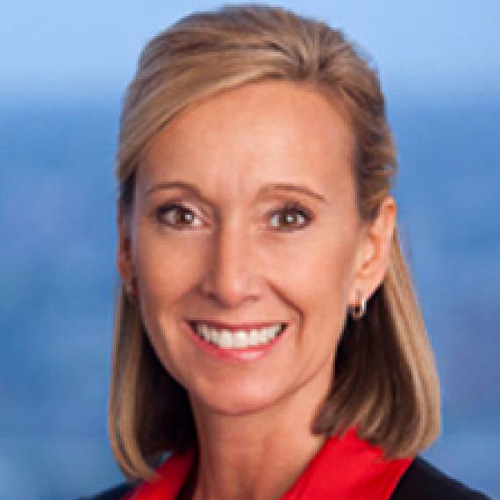
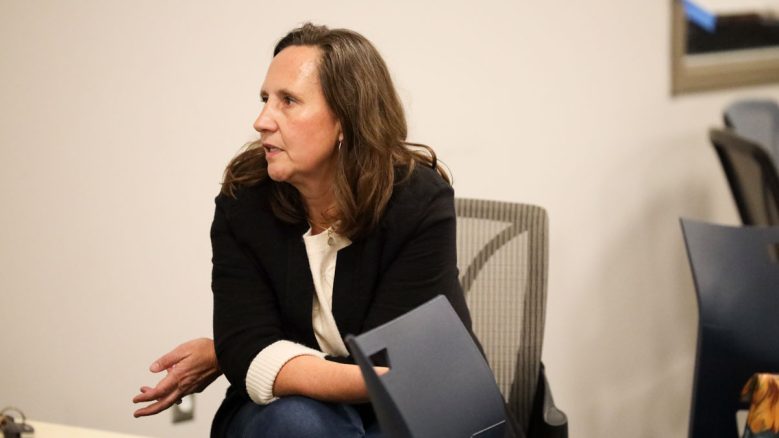
Castle is a professor of practice in KU’s schools of law and business, as well as a lecturer in the university’s political science department. She practiced as a lawyer for 20 years and was a law clerk to three federal judges. She’s an at-large member of the Douglas County Democratic Party.
Proctor proposed this amendment on the Nov. 3 ballot. He is a Republican representing Kansas District 41, as well as a veteran and an assistant professor in the Homeland Security Program at Wichita State University. He is currently running for Kansas secretary of state — the position that administers statewide elections. (See this link for coverage of the secretary of state race.)
Jump to a question
• How does the language of the proposed amendment change the constitution?
• What happens if the majority of Kansans vote “yes”?
• If this amendment is redundant, why propose it at all?
• Is there evidence that people without citizenship status are voting in state or federal elections?
• Why do people keep bringing up documentary proof of citizenship?
• What does or doesn’t this amendment have to do with voter disenfranchisement?
• How do I vote?
How does the language of the proposed amendment change the constitution?
Section 1, Article 5 of the Kansas Constitution outlines who can vote, and the beginning of that section reads, “Every citizen of the United States who has attained the age of eighteen years and who resides in the voting area in which he or she seeks to vote shall be deemed a qualified elector.”
Please support
The Lawrence Times!
Subscribe here.
The proposed amendment to the Kansas Constitution would reframe that language to define who can’t vote:
“(a) No person shall be deemed a qualified elector unless such person:
“(1) Is a citizen of the United States;
“(2) has attained the age of eighteen years; and
“(3) except as provided in subsection (b) or (c), resides in the voting area in which such person seeks to vote.”
Read the full revision and the explanatory language that legislators approved for voters’ ballots at this link.
What happens if the majority of Kansans vote ‘yes’?
“It doesn’t sound like that big of a deal or that big of a change to our state constitution,” Castle said.
And if the amendment does pass, nothing would happen until the next legislative session, she said.
Castle, and many voting “no,” are concerned that this amendment will pave the way for the Republican Party to push laws that require documentary proof of citizenship to vote, ultimately creating barriers that disenfranchise thousands of citizens.
Proctor said these are conspiracy theories put forward by groups like the League of Women Voters and the ACLU.
“This law in no way ushers in documentary proof of citizenship,” he said. “… This constitutional amendment is about protecting the laws that are already on the books.”
If this amendment is redundant, why propose it at all?
Proctor said the amendment would prevent trends he’s seeing in other states from coming to Kansas.

“You might think that that’s a distinction without a difference,” he said of the revision, “but California, Maryland, and Vermont have the exact same language that we have in our Constitution — that every citizen can vote — and all three of those states allow noncitizens to vote.”
It is illegal for people without citizenship status to vote in state or federal elections, and there are criminal penalties. But some locales permit legal voting in local elections. For example, some people without citizenship status in San Francisco can vote in school board elections if they meet certain requirements.
“Nobody’s proposed that we allow noncitizens to vote in Kansas, right? And it’s not like a wave of jurisdictions are doing this,” Castle said.
When asked if anyone in Kansas had pitched the idea, Proctor pointed to a comment Jennifer Day made. Day is the Democrat running against him to be secretary of state.
“I think there are spots in California where you can vote as an immigrant who is not a citizen in their municipal elections, their local municipal elections. That is not the case in Kansas, unfortunately,” Day said during a talk with the Douglas County Democratic Party.
In general, Proctor said the amendment fits into his general campaign to restore “confidence in our elections because so many folks have lost faith in the process.”
“And the way I’ve been doing that is by increasing transparency, by combating noncitizen voting and ballot harvesting, and by cleaning up our voter rolls,” he said.
One of his initiatives is to advance legislation to remove inactive or deceased voters from the voter rolls through the SAVE Kansas Act. That bill also allows voter rolls to be compared against the federal Systematic Alien Verification for Entitlements (SAVE) database and Kansas Division of Vehicles database. Proctor said the goal was to remove ineligible voters.
The ACLU, on behalf of the League of Women Voters, sent a letter to current Secretary of State Scott Schwab saying the bill might violate the National Voter Registration Act of 1993.
Proctor said the United States is unlike any other nation “in the history of the planet Earth.”
“The reason it works, the reason we’re able to keep a nation of such different people held together, just by principles, is elections,” Proctor said. “Our founders discovered the secret sauce.”
Is there evidence that people without citizenship status are voting in state or federal elections?
Both Proctor and Castle said it happens infrequently.
“There’s not a vast conspiracy for noncitizen votes in the state of Kansas,” Proctor said.
Castle said the evidence is “statistically insignificant.”
The Heritage Foundation, a conservative think tank, maintains a map of proven instances of fraudulent voting.
“While not comprehensive, this map demonstrates vulnerabilities in the election process and the ways in which fraud is committed,” the database homepage reads.
Between 1982 and 2025, the foundation identified one proven instance of someone without citizenship voting in Kansas.
Proctor highlighted Joe Ceballos — the former mayor of Coldwater, Kansas, and a legal permanent resident but not a citizen — who was charged with voting illegally in 2025. Kansas Attorney General Kris Kobach said he used the federal SAVE database to prosecute Ceballos. Proctor’s SAVE Kansas Act supports the use of that database.
Kobach said in November 2025 that the state would likely find hundreds of similar cases using the database. September reporting from the Topeka Capital-Journal shows that number sits at four; Kobach said he has more than 15 “referrals.”
Castle said the low incidence of this type of fraudulent voting is evidence in favor of the current system. When somebody registers to vote, they have to sign an agreement attesting to their citizenship and Kansas residence. The penalty for violation can be deportation.
“It doesn’t sound like hugely robust procedures that we have, but again, we don’t really need them because noncitizens are not trying to vote,” she said.
Proctor also said the low numbers were proof that existing deterrents worked, but he asked, “How many is too many?” His answer is one.
“Every time a noncitizen votes, they are canceling out the vote of a valid Kansas voter,” he said. “They’re canceling out your vote or my vote or some other Kansas vote.”
Castle keeps asking why focus on this issue if it’s so limited?
“It’s a boogeyman. It’s a solution in search of a problem,” she said.
Why do people keep bringing up documentary proof of citizenship?
Castle and many in the vote “no” camp hypothesize that the amendment is a Trojan horse for Republican legislators to impose more restrictions on the voting process.
“They have tried to restrict voting in so many fashions in the past, I have no doubt that they will use this amendment to attempt to justify further restrictions, and in particular, requiring proof of citizenship to register to vote,” she said.
Documentary proof of citizenship, or DPOC, requirements for voting would mean that Kansans can’t use just any government-issued photo ID, like a driver’s license, to vote. Most people would need something like a birth certificate or passport.
Kobach introduced a law that required DPOC for voter registration. Called the Secure and Fair Elections (SAFE) Act, it took effect in 2013 until a federal judge ruled it unconstitutional in 2018.
The appeals court’s opinion said the act disenfranchised 30,000 Kansas voters.
Proctor said that, because of this ruling, the state Legislature can’t build the Trojan horse.
“If anybody tried to bring that law, I would advise them that they are, first of all, passing a law that was already passed … and then I would tell them that that’s already been ruled unconstitutional, and we won’t be able to enforce it,” he said.
If resources like this are helpful to you, please support The Lawrence Times.
Click here to subscribe.
He has his eyes on the federal Safeguard American Voter Eligibility (SAVE) America Act, which was stalled in the Senate. If passed, it would require DPOC for voter registration nationwide.
“While I love everything in the SAVE Act, I would like to see the states have the ability to decide how their elections look, rather than asking the federal government to do it for us,” he said.
Castle said she doesn’t trust Proctor not to try and get around the ruling on Kobach’s SAFE Act.
“It was a federal ruling; we’re talking about a state constitution,” she said. “There are all different kinds of ways that they can try to say, ‘Oh, well, that case doesn’t apply here.’”
She said even if Proctor is correct that the federal ruling would bar another DPOC law, Republicans could yet find a workaround.
“If you require proof of citizenship to get your Real ID, and then you require your Real ID to vote, you’re doing the same thing, you’re just doing it through an alternative path,” she said.
She referenced a bill Proctor put forth that would mandate that Real IDs indicate if the cardholder is a citizen or not. That bill did not pass.
Proctor said it wouldn’t have changed anything about the Real ID process, as citizens are already required to show DPOC to get a Real ID, even if it isn’t for the purpose of confirming citizenship. People who are not citizens, likewise, must share documentation that ultimately confirms their status.
“This bill would not add anything to this process,” he said. “The DMV already knows who is a citizen and who is not a noncitizen.”
What the bill would have done, he said, was give them a list of names to check against the voter roll to snuff out fraudulent voting. He hopes to revive the bill in future legislative sessions.
Castle said that bill could also lead to discrimination if a person is pulled over and their license says they’re not a citizen.
What does or doesn’t this amendment have to do with voter disenfranchisement?
Castle is dubious about the amendment in part due to Proctor’s legislative history. For example, he’s sought to limit advance voting and eradicate mail-in ballots.
“Any time there is a barrier to voting, it’s going to disenfranchise people from being able to exercise their right to vote,” Castle said.
If DPOC were required to vote, she said the impacts would be widespread. If the name on a passport or birth certificate doesn’t match a voter’s current name, then they could be barred from voting, citizen or not.
The No. 1 target, in Castle’s view, is women voters.
Castle said women who married and changed their names, sometimes multiple times, would have to locate documents like marriage certificates to prove their birth certificates are theirs.
“Women who change their name are going to have to come with extra documents to prove that they are the person set forth in their birth certificate,” Castle said. “… And so that would be very bad for women voters. And there are lots of women Republican voters, but as a tendency, women tend to vote more Democratic.”
This birth certificate conundrum could also affect transgender people who changed their names, or folks born outside of hospitals who didn’t have birth certificates to begin with.
2024 Research from the Brennan Center for Justice additionally showed that “11% of American citizens of color who are voting age are unable to readily access documentary proof of citizenship.”
DPOC requirements can also target low-income communities, according to Castle. It costs $20 or more to get a copy of a birth certificate in Kansas, and upward of $130 for adult passport book applicants.
Then, only government employees can evaluate DPOC, so citizens could only register to vote at election offices or the DMV.
Those offices have limited hours, so voters might have to take time off of work to register. It could also force rural Americans to drive long, in some cases prohibitive, distances to register.
“That’s not a bug; it’s a feature,” Castle said.
To Proctor, all of the above is a nonstarter — and they are not going to ask women to root out their marriage certificates — in part because of the ruling on the Kansas SAFE Act.
“So the people that are saying that this is going to usher in documentary proof of citizenship are either uninformed or, frankly, lying because they don’t want it to pass,” he said.
How do I vote?
Polls will be open from 7 a.m. to 7 p.m. Tuesday, Nov. 3, and early voting got underway Wednesday, Oct. 14.
Find more voting info at lawrencekstimes.com/election2026.
If local news matters to you, please help us keep doing this work.
Don’t miss a beat — get the latest news from the Times delivered to your inbox:
Click here to learn more about our newsletters first

Wulfe Wulfemeyer (they/them), reporter and news editor, has worked with The Lawrence Times since May 2025. They can be reached at [email protected].
Read their complete bio here. Read their work for the Times here.
More coverage: Election 2026

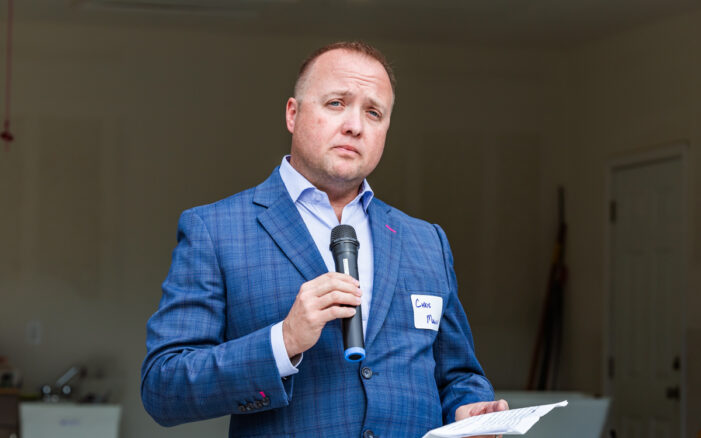 Molly Adams/Lawrence Times

Latest Lawrence news:
 Molly Adams/Lawrence Times
 Molly Adams / Lawrence Times