


The Lawrence school board ended its AI committee after the group met only four times and had no chance to recommend specific policy, all more than two years after the board announced the creation of the committee.
When school board members agreed to form the AI committee in June 2024, they said the technology was moving at an extremely fast pace and laid out a broad charge for the committee to recommend guidelines, practices and policies. The district didn’t start seeking applicants for the group until November 2025.
More than two years after the board’s initial charge, some committee members said they felt the group was only able to discuss broad topics, couldn’t workshop specific ideas, and that the district didn’t devote proper attention to the group.
The committee’s findings, made up of broad guidelines, were presented to the school board in August, more than a year later than originally planned. Committee members said they never discussed or agreed on what to share with the board.
Get daily news in your inbox: Sign up for our email newsletters
Learn more about our newsletters first at this link
Some members of the group got together to write their own policy recommendations about student privacy and sent them to the school board.
“There were no opportunities, really, for members of the committee to do anything productive,” said Katherine Morse, a member of the committee and parent of children in the district.
Please support
The Lawrence Times!
Subscribe here.
She said the committee rarely met, and dwindled in size over time. Meetings often consisted of brainstorming and discussion, but didn’t lead to clear recommendations.
That wasn’t due to a lack of desire from committee members, Morse said, but because the committee never seemed to have a clear objective. The group generally had a consensus on ideas such as protecting student privacy and providing AI literacy training for teachers, she said.
“We did not come up with a final set of guiding principles or something to be presented to the board,” said committee member Christin Bowman, who works in tech and is the parent of two young children. “We wanted to, but we never did.”
Bowman said she felt the committee was never given the chance to discuss an important question: Should the district use AI at all?
“While we were in these meetings, it felt like there was an agenda a bit on their end where they were hoping for us to talk about all the great things AI could do for schools and how we could just make sure that if we’re doing all those great things that we put some guardrails,” she said. “But a lot of us were feeling a lot more conservative about AI than that.”
School board members said they recognized the group’s charge could have been more clear, but that the group’s conversations were helpful and would continue to guide the district as it looks to implement policy.
The guidelines presented to the board in August from the committee fell into three major categories: data privacy, academic integrity and AI literacy.
School board member Matt Lancaster, who was on the committee, said the board was able to hear “well-researched thinking and concerns around AI” and was ready to use the ideas in the future. He said the group did look deeply at topics ranging from academic integrity to parental consent.

“I think the rub here is the ‘policy recommendation’ piece, which is a step further in the process and could have been more clear,” he said.
He encouraged committee members to continue reaching out to the board and said he was open to reforming the committee.
“I understand the frustration about not directly issuing policy,” Lancaster said. “but this group played its part in the broader policymaking process which now continues — it’s something we want to get right.”
Another part of the frustration from committee members about the lack of specific policy recommendations is because of the rapid pace of AI’s development and use by students.
More than half of teens nationwide say they use AI to help with school work, and roughly 1 in 5 student interactions with generative AI on school technology involve cheating, self-harm, bullying and other problematic behaviors.
“I think that the more that wheels are spun, the longer we just put students at risk of basically being used as guinea pigs by AI companies,” Morse said.
The committee wasn’t formed until more than a year after the original school board charge. At that point, Superintendent Jeanice Swift said she anticipated a proposal for the board to adopt by early 2026, which did not happen.
At the August meeting, Swift said the district would form a teacher work group to assess the guidelines, and policies would be ready for implementation for the 2027-28 school year — more than three years after the board agreed to form the committee to address the emerging technology.

School board President Bob Byers said the committee was successful in being the district’s starting point on AI work.
“It’s crucial that we understand how AI will impact education,” he said. “It’s important to realize that AI will be used by students and teachers, and the challenge is to determine the appropriate ways to use it.”
Katie Conrad is a professor in the department of English at the University of Kansas and has studied critical AI literacy in education. She authored “A Blueprint for an AI Bill of Rights for Education” and has sat on panels and committees discussing the topic.
“Since the technology moves quickly, you need to establish principles that you hold up, regardless of the technology you have,” she said.
On the district committee, she said, much of her insight was ignored. She said it seemed to her the district had a pro-AI viewpoint and the critical approach brought by many in the committee was overlooked.
“It felt like a kind of performative gesture,” Conrad said.
Similar frustrations were raised by members of the district’s Futures Planning Committee, which was tasked in 2022 and 2023 with analyzing options for potential district budget cuts.

Board member GR Gordon-Ross, who also served on the AI committee, said groups often have to balance different types of discussions. He said policy comes from the board’s policy committee.
“We could have explained that process more clearly, and been more transparent about it, from the start of the committee’s work,” he said.
Although the AI committee was over, he said the district’s work on AI policy was continuing.
“Whenever you form a committee around a new topic the district has never discussed, and people hold strong feelings about what the outcome should be, some of them will ultimately be disappointed,” Gordon-Ross said. “I’m grateful for the time and expertise the members gave, and it was never our intention to undervalue the people who volunteer to help us be better.”
A spokesperson for the school district did not respond to questions for this article by the time of publication.
If local news matters to you, please help us keep doing this work.
Don’t miss a beat — get the latest news from the Times delivered to your inbox:
Click here to learn more about our newsletters first

Cuyler Dunn (he/him), staff reporter, has worked with The Lawrence Times since April 2022. He can be reached at [email protected].
Read his complete bio at this link. Read more of his work for the Times at this link.
Latest Lawrence news:


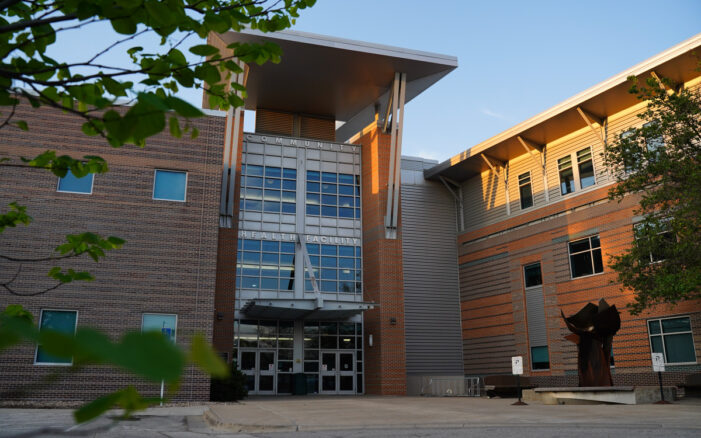
 Maya Smith/Lawrence Times