

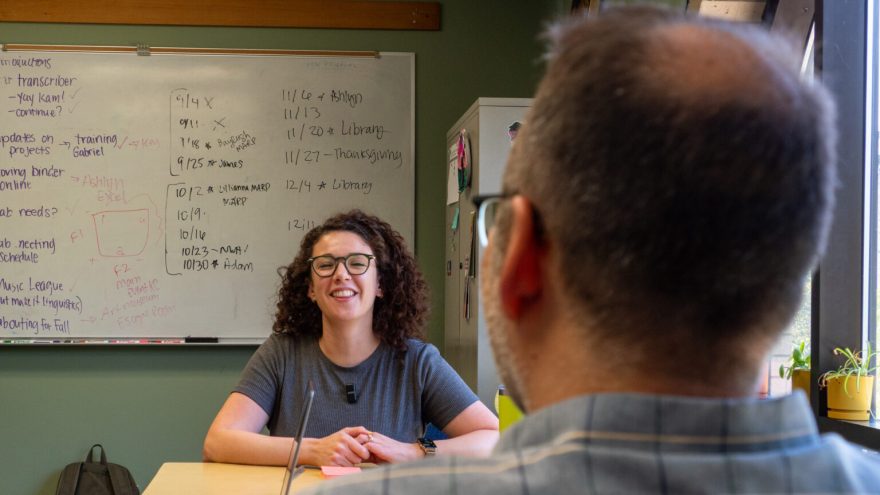
Linguists at the University of Kansas revealed that the way Kansas speak is much more diverse than some people think, and perceptions of a Kansas accent differ, depending on whether listeners are Kansans or non-Kansans.
Yes, Kansans do have an accent.
“There is no such thing as an accentless way of speaking,” said Lacey Wade, a linguist and assistant professor at the University of Kansas, “and we’ve been able to identify a few features that we do see in Kansas speech.”
Kansas is often left out of traditional studies of linguistic variations based on geography. Wade and fellow assistant professor and phonetician Jeff Holliday, along with co-author Tyler Hausthor, published a paper in August in Duke University Press to fill that gap.
Don’t miss a beat … Click here to sign up for our email newsletters
Click here to learn more about our newsletters first
In an interview on the Kansas Reflector Podcast, Wade and Holliday said Kansans often associated Kansas speech with a neutral accent, while non-Kansans largely associated it with Southern-accented voices.
“I think what’s going on is there’s a state, a part of the country, that has a name and people know that this place exists, but they don’t know much about it,” Holliday said. “And so when you ask them, well, ‘How do you think they talk?’ they actually don’t have much experience with that.”

Wade pointed to the AppleTV sports comedy sensation “Ted Lasso” as a prime example of the disconnect between the perceptions and reality of Kansas speech. The titular character is a football coach from the Kansas City area, yet he speaks with a distinct “country Southern accent.”
Jason Sudeikis, who has played the character for four seasons, described his hometown as Overland Park, located outside the Kansas City metropolitan area. He graduated from Shawnee Mission West High School and attended Fort Scott Community College, and he doesn’t “actually sound like that in real life,” Wade said.
His character puts on an accent and plays a character associated with stereotypes of what a rural accent sounds like, Wade said.
“People will often use accents of characters as sort of shortcuts to whole hosts of personality traits that they want to convey very quickly,” Wade said. “And the quickest way to convey that is through somebody’s accent.”
One of the major takeaways from their research, Wade said, was the finding that Kansas is linguistically diverse, despite perceptions to the contrary.
In their research, Wade and Holliday played participants clips of accents from throughout the United States. Kansans struggled to identify Kansas speakers from Salina and Dodge City as being from Kansas. They received higher accentedness ratings compared to speakers from the rest of the state or Kansas City.
One of the Southern accent features Wade and Holliday discovered in Kansas speech was a linguistic phenomenon called the “pin-pen merger,” which occurs when a speaker pronounces “pin” and “pen” the same.
They observed another feature of Kansas speech in pronunciation of the “a” vowel sound that is most commonly associated with California speech, or the typical “valley girl” accent. In their observation, “hat” sounded more like “hot,” especially in younger Kansans.
Kansans recognize variety in Kansas speech, distinguishing differences in speech between eastern Kansas and western Kansas. Simultaneously, they have a perception that a Kansas accent is neutral persisted, Wade said.
Their research could be classified as “folk linguistics” because of its focus on the way people think and feel about Kansas speech, which Wade and Holliday said was the best way to glean information about how language functions in different dialect regions of the country.
“The words and the sounds that come out of your mouth, that is a reflection of you and all of your experiences,” Holliday said. “I talk this way —the way that I’m talking now — because of where I was raised, where I’ve lived, who has been in my life that influenced me, and how I’m trying to present myself to the world.”
He added: “That’s a beautiful thing, I think, and that’s true for everyone. What we want to understand is why is language like that?”
Wade and Holliday’s research is ongoing, and people who grew up in Kansas and are 8 years old and up can participate by visiting sociolinguistics.ku.edu/outreach or emailing [email protected].
Kansas Reflector is part of States Newsroom, a network of news bureaus supported by grants and a coalition of donors as a 501c(3) public charity. Kansas Reflector maintains editorial independence. Contact Editor Sherman Smith for questions: [email protected]. Follow Kansas Reflector on Facebook and Twitter.
Don’t miss a beat — get the latest news from the Times delivered to your inbox:
Click here to learn more about our newsletters first
Latest Lawrence news:
 Debi Taylor/Contributed photo
 Nathan Kramer / Lawrence Times
 Cuyler Dunn/Lawrence Times