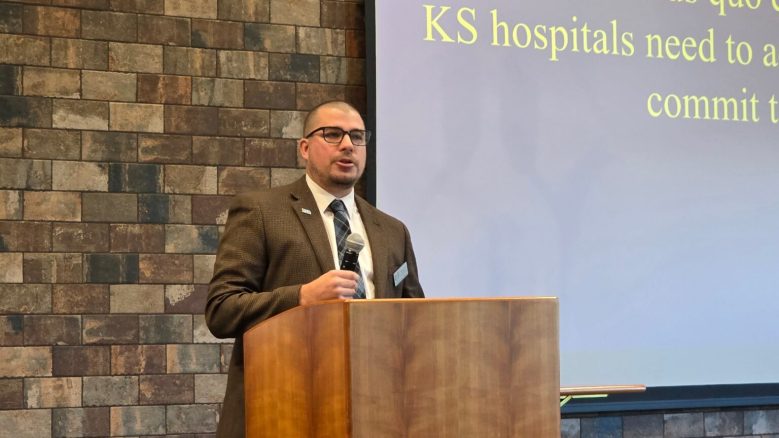

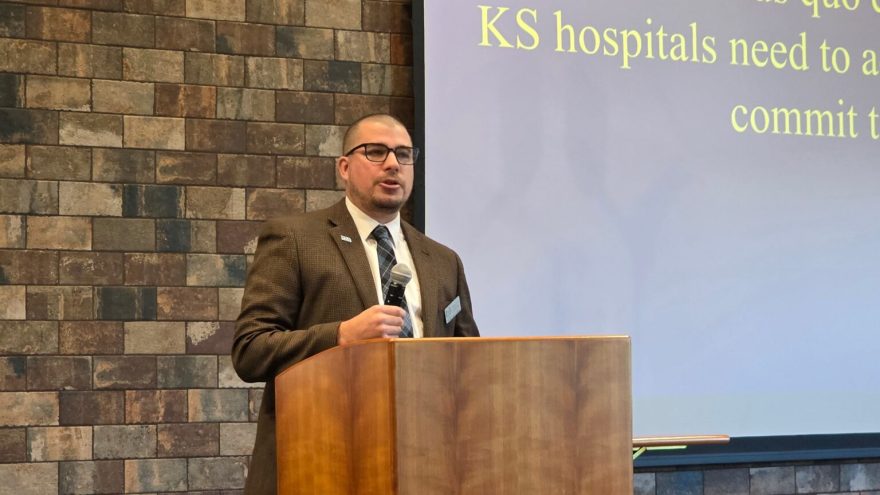
TOPEKA — A statewide health organization is coordinating efforts to change the way Kansans burdened with medical debt are treated by providers and the legal system.
“We see people avoiding even getting care if they know that they’re going to incur medical debt,” said April Holman, executive director of Alliance for a Healthy Kansas, at a Tuesday meeting in Topeka. “We know that when there is medical debt putting strain on those family budgets, that means that there is less ability to afford housing and food and transportation.”
One in five Kansans lives in a household burdened by medical debt, she said. The alliance, which represents 130 organizations concerned about affordable healthcare, is known for working to expand Medicaid in Kansas.
Now it is pulling together groups that are interested in changing how medical debt affects families and want to look at data and best practices that could be put into Kansas legislation.
The alliance began with five community listening sessions in October and a survey to hear concerns about medical costs and debt, said Marissa Alcantar, policy and advocacy manager at the alliance.
Don’t miss a beat … Click here to sign up for our email newsletters
Click here to learn more about our newsletters first
Worries about rising healthcare costs were the overarching theme, she said. Participants talked about decreased employer health insurance contributions, rising deductibles and out-of-pocket costs, and how overwhelming it is to receive multiple bills after care, Alcantar said.
“Another big thing that we talked about was just the lack of transparency around the cost of healthcare,” she said. “People felt they didn’t have enough understanding or information on costs for services and how those services are billed to patients, how their insurance plays into that.”
The data
Kansas Legal Services would like to see the government and hospitals make changes to medical debt practices. The nonprofit’s attorneys see the result of medical debt play out in the cases it represents, said Casey Johnson, director of advocacy and innovation at Kansas Legal Services.
They helped gather data about court cases, he said.
It isn’t an easy process, said Linda Sheppard, a principal strategist in state and federal health policy at the Kansas Health Institute. Each case has to be examined individually because there is no way to search the court computer systems to determine which collection cases were related to medical debt, she said.

They ended up choosing six counties and specific dates to pull a sampling, she said.
They found people in court for medical debt as low as $39 and a significant number of cases that resulted in default judgments, meaning the debtors did not show for court, Sheppard said.
For example, on a single day in Shawnee County, there were 69 medical debt cases, 90% had no attorneys, and 81% of those resulted in default judgments, Johnson said. Twenty percent had orders for wage garnishment.
Legal representation
Johnson said there are real concerns about debt collection cases that don’t have representation.
“KLS has been challenging wrongful debt collection cases by nonprofit hospitals, and so far we won every one,” he said. “We’ve settled on all of them because the rules are clear: You have to have a charity care policy, you have to widely distribute that, and you have to try to determine whether people qualify before you sue them, and that’s not happening.”
The legal service has represented 38 defendants who were sued by 16 nonprofit hospitals, Johnson said. They’ve had $400,000 forgiven or returned, if it had already been garnished.
When people don’t show up for court dates or don’t have representation, they don’t know the regulations that are put on nonprofit hospitals, such as widely advertising their charity care policies.
“These are, for the most part, people that are very low-income,” Johnson said. “One of the things that we see, too, when you’re filing a case in limited actions, which includes most debt collection cases, there’s no requirement if there’s any supporting documents. We see these bare bones petitions.”
Johnson shared examples of one- to two-page documents that were the only court submissions, with no detail of services received.
“They say sunshine is the best disinfectant, so we’re shining a light today on this epidemic of no attorneys in collection dockets,” said Matthew Keenan, Kansas Legal Services executive director. “Debt buyers are infiltrating this very receptive system that we have here, and they’re doing what Casey describes: no documentation.”
Serving debtors
The debtor must be notified about a court hearing, but there is no requirement in Kansas that debt collectors find a current address, Johnson said.
“What’ll happen is a lot of times debt collectors will have a four- or five-year-old address,” he said.
When they try to serve papers and no one is home, they post a copy on the front door and then mail a slip notifying them at that same address that they posted the paperwork on the front door.
“A lot of times, what we find is that our clients are very transient,” he said. “Years down the road, the debt collector finds out where they work or where they bank, and they start getting garnished, and that is the first time that somebody finds out that they were sued.”
Half of the people who end up with a default judgment, which occurs when one party in a lawsuit doesn’t show up and the judge makes a ruling against them, may not know they have been sued, Johnson said.
Their paychecks are garnished, which federal regulations set at a maximum of 25%, he said. Some states lowered that amount, but Kansas hasn’t.
Karen Braman, senior vice president with the Kansas Hospital Association, said hospitals are concerned about medical debt.
“Costs have just absolutely surged in recent years, and that really started during the pandemic, and we saw issues with labor costs tripling, and some of that has not slowed down,” she said. “Many Kansans remain uninsured and underinsured due to Kansas not being a Medicaid expansion state. It’s only getting worse.”
Braman said hospital expenses are growing at about twice the rate of reimbursements.
“Our workforce accounts for more than half of hospital costs, about 60%,” she said.
Many rural hospitals are at risk in Kansas, Braman said.
“In the most recent Kansas data that we have, 81% of Kansas hospitals had an operating loss in 2024,” she said. “The average operating margin across every Kansas hospital in 2024 was minus 7%. So we’ve got a situation here where the pressures and the needs of high labor costs and the drug costs and supply chain costs are going up, yet our hospitals’ margins are shrinking, shrinking, shrinking, and their ability to even stay open in some of our rural communities is at risk.”
Best practices
Maanasa Kona, an associate research professor with the Center on Health Insurance at Georgetown University, spoke to the group about legislation and changes other states have taken to address medical debt problems.
She said states can consider protections at multiple levels in the healthcare process, such as requiring hospitals to share their charity care programs and assess patients for financial assistance, limiting the amount of interest that can be charged, and setting conditions or guardrails around when medical debt can be assigned to collection agencies.
The state also could limit wage garnishment, which is federally set at 25% of an individual’s salary. Some states have set up sliding scales, with smaller percentages for those who make less income, Kona said.
“Colorado requires screening of uninsured patients both for public coverage, that’s Medicaid, as well as for financial assistance, unless the patient declines,” she said. “At an earlier point, so that before a bill can be sent off to collections, insured patients in Colorado can also request screening.”
It is important to take as much of the burden as possible off of patients, Kona said.
“They’re already clearly in a tough time of their lives, and then putting the onus on them to become aware of these processes, to fill out the paperwork, and to advocate for themselves might be a bridge too far,” she said.
Kansas Reflector is part of States Newsroom, a network of news bureaus supported by grants and a coalition of donors as a 501c(3) public charity. Kansas Reflector maintains editorial independence. Contact Editor Sherman Smith for questions: [email protected]. Follow Kansas Reflector on Facebook and Twitter.
Don’t miss a beat — get the latest news from the Times delivered to your inbox:
Click here to learn more about our newsletters first