
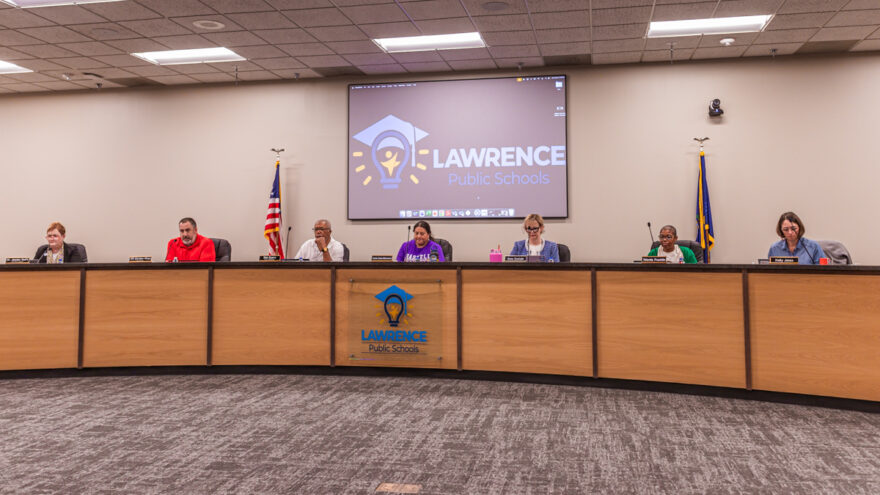
The Lawrence school board on Monday approved a tax incentive for a project to develop vacant land at the northwest corner of East Ninth and Delaware streets into apartments.
As one of Lawrence’s three taxing entities, the district was asked to participate in a Neighborhood Revitalization Area for the 9 Del Lofts II apartment project at 716 E. Ninth St. Tom Kaleko, Baker Tilly municipal adviser, said there is no cost to the district.
With a 5-2 vote, the board approved the request, which was for a 15-year, 95% tax rebate on the increased property value resulting from the project. Yolanda Franklin and Carole Cadue-Blackwood were the dissenting votes.
Franklin said she knew before the meeting that she would be opposed to the incentive. She said although the district will not lose money from participating, the development does not benefit families in the district because all 36 units will be one-bedroom. Cadue-Blackwood said she’s concerned about future gentrification of East Lawrence.
Board members asked for clarification on who the apartments will serve, and Kaleko said it will be “quality housing that is affordable to people of modest means.” He compared them to recent developments, such as Penn Street Lofts.
“That would have been truthful, that would have been transparent — if we’d have known that from the very beginning,” Franklin said. “But when you throw ‘affordable’ in front of it, then you have the district thinking that it’s affordable housing for even a father with one child and gives the child a one bedroom while he sleeps on the couch. That’s still not affordable.”
Tony Krsnich, developer with Flint Hills Holding Group, said he knows of single parents and parents with joint custody living in similar developments in Lawrence.
“I’ve made the mistake in the past of having three bedrooms, four bedrooms, two bedrooms and multifamily elevator buildings,” Krsnich said. “Unfortunately, it’s just not a very good setup for what I’m going to call a traditional family.”
The board asked questions about the income qualifications that prospective tenants would have to meet, and whether some district staff members would qualify to live there.
If an education support professional was making $14.56 per hour — the minimum wage the district is currently offering in negotiations with the union — for 40 hours per week and 52 weeks per year, their income would be $30,284 annually. However, many ESPs do not work 52 weeks per year.
For a household of one in Lawrence, 50% of the area median income — a value set by the federal Department of Housing and Urban Development — is $36,250, and 30% of the AMI is $21,750. Many classified staff members would have incomes low enough to qualify for housing in 9 Del Lofts II.
Board member Shannon Kimball said it’s important for the district to maximize opportunities for additional revenue.
“There are not very many ways that we can truly impact property taxes without also taking away dollars that are available for our operations,” Kimball said. “And so, yes, improving a property and increasing that tax base in this way is actually one of the ways that we get to do that.”
Several board members said they would like to be brought to the table earlier for future potential developments. Board President GR Gordon-Ross said the school board can be put in a difficult position.
“No offense to the city, I’m not up here, nor was I voted, to solve low-income housing,” Gordon-Ross said. “I was voted to support teachers, students, staff and families within my district, and this particular project does that to some extent, and it doesn’t on the other hand, and we’re always put in this position of having to decide which side of that line we want to fall.”
See the approved NRA agreement attached to the meeting agenda item on BoardDocs.
Budget approval
The board on Monday also approved the district’s 2025-26 budget on a 7-0 vote.
At its Aug. 11 meeting, the board set a maximum mill levy for the 2025-26 budget that will result in a property tax increase. The mill levy is set at 52.333, which is .057 mills more than the 52.273 for 2024-25.
One community member, who opposed exceeding the revenue neutral rate, participated in the public budget hearings at the start Monday’s meeting.
Although the rate increase is fairly small, most property owners in Lawrence and Douglas County saw their assessed valuations increase by 5% or 6% on average. To keep property taxes flat, the school board would have had to lower the mill levy.
Local option budgets allow districts to supplement funding through local property taxes or per-pupil state aid. The district will have authority to operate its LOB at around 33% of the general fund, which is the maximum allowed by the state.
Cynde Frick, executive director of finance, said at the Aug. 11 meeting that because the state determined the district’s assessed valuation per pupil is higher than others, the state will likely not provide the district with any LOB aid this year.
The district’s declining enrollment will also offset an increase to the base per-pupil state aid for the general fund, Frick had said.
If local news matters to you, please help us keep doing this work.
Don’t miss a beat … Click here to sign up for our email newsletters
Click here to learn more about our newsletters first

Maya Hodison (she/her) reported with The Lawrence Times from July 2021 through January 2026. Born and raised in Lawrence, she enjoys focusing on issues that people in marginalized communities face and amplifying voices that are oftentimes unvalued. Read more of her work for the Times here.
Latest Lawrence news:

 Cuyler Dunn/Lawrence Times