


Lawrence police officers fielded questions about privacy and cooperation with federal agencies at an event Wednesday night focused on the department’s use of a controversial camera registration and integration program.
Axon Fusus is a program where residents and businesses can volunteer to register their security cameras and contact information with the police department, allowing police to know where cameras are located and request footage if a crime occurs nearby.
Police do not have access to the video feeds of residents. However, businesses can purchase custom tech to integrate their cameras with the police, allowing the police to access cameras in realtime under parameters set by the business.
LPD announced the rollout of the program, which it calls Community Connect, last year. Soon after, some community members and experts said they were concerned about possible privacy issues. Some of those community members organized the Lawrence Transparency Project and convinced the city commission in September to pause the implementation of the program and order the police to work with the community to create safeguards.
Don’t miss a beat … Click here to sign up for our email newsletters
Click here to learn more about our newsletters first
Kincaid Dennett, who leads the Lawrence Transparency Project, said they were frustrated because the police have continued integrating city-owned cameras since the pause. Lawrence Police Chief Rich Lockhart said it was his understanding that was OK under the city commission’s order.
Some conversations Wednesday were tense, with multiple people talking over each other to ask pressing questions of Lockhart. At one point, Lockhart said “There’s nothing, right? There’s nothing I can say or do that’s going to make you say ‘I can live with this.’ I know that, and that’s cool.”

“We had some really intelligent conversations,” Lockhart said after the event. “I really appreciate that.”
Please support local news and information from The Lawrence Times.
Subscribe here.
Community members voiced a slew of concerns and questions at the event, but they primarily centered on two topics: privacy of stored video, and concerns about federal agencies attempting to get access to the camera footage.
Ben Hellebust, who studies computer engineering at KU, said his primary concern was security of the video once it was collected.
Video would be stored on the police department’s internal servers and eventually deleted. Video clips related to a criminal investigation would be stored in Axon’s digital evidence storage system.

Hellebust said he was worried about a possible data breach, which he said is becoming more common, even for places that pledge to keep data secure.
“The idea that this is going to be deeply secure, it has no evidence of that,” Hellebust said.
Axon has not experienced a widely public breach of its digital evidence service. Lawrence Police Sgt. Drew Fennelly told some community members Axon has a vested interest in keeping information secure because its entire business rests on that responsibility.
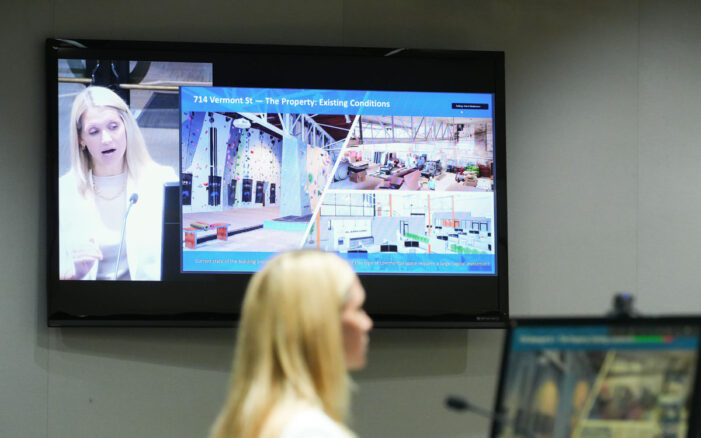
Wednesday’s event was to look over a draft policy the department has put together guiding its use of the system.
Here’s a PDF from photos of the draft policy:
20260429-Axon-Fusus-draft-policy-A4-compressedSome community members said they were concerned about whether that was enough accountability.
“The oversight is themselves,” Hellebust said. “They’re being held accountable to themselves.”
One worry community members voiced about the integration program was that businesses that agree to give the police access to their security cameras wouldn’t be required to notify customers. They said despite the cameras already existing, it matters who has access to that footage. Many of them were uncomfortable with more police access to cameras.
“With great tools comes great responsibility,” Oliver Pepin said. “Such a tool like this can help enforce oppressive biases.”

Lockhart deferred much of the communication responsibility to the businesses. When community members said they would be uncomfortable with police having access to business cameras, he said they should talk to those businesses about those concerns.
A few community members said they had less apprehension about the registration part of the program, in which the police would create a list of where people have cameras at their homes. Hellebust said the registration program poses fewer data security concerns in his eyes and is something he would have “basically no issues with.”
“That is something we could think about,” Lockhart said of only advancing the registration program. “And that’s one of the things that, if that’s a concern people brought up tonight, I want to evaluate that and see.”
Many community members asked about federal agencies, like Immigration and Customs Enforcement, who may want access to video footage.
Lockhart said the video footage is only accessible by Lawrence police, and the only way federal agents could gain access is if the video was evidence of a crime. Being present in the United States without documentation is not a crime.
But some community members said they were worried the police could choose to comply more with federal officers and give over video footage even if they weren’t required to.
Brooklynne Mosley, a state representative for Lawrence, said she was worried the state could pass legislation forcing the city to hand over more of its video data to federal agencies.
Mosley also asked about safeguards for local officers who misuse the tool. For example, a former Lawrence police officer lost his law enforcement certification in 2022 after he was charged with misusing his credentials to seek out information about the driving records of the mother of his child amid a custody case.
Lockhart said anytime someone wants to look at camera footage they have to enter a reason for the search, and every action taken in the system is logged. He said they would audit that information to track for suspicious activity.
Axon is the police department’s vendor for a handful of services, including body cameras, digital evidence storage and the camera registration program.

One expert over the summer said this was part of a business strategy by police technology vendors to bundle more services together to encourage police departments to buy more. It was a concern raised by a couple of community members Wednesday.
Lockhart said he never prefers when the department’s business is centralized in one company, but he’s comfortable with Axon because the company is bound by Criminal Justice Information Services, a branch of the FBI that sets strict cybersecurity requirements.
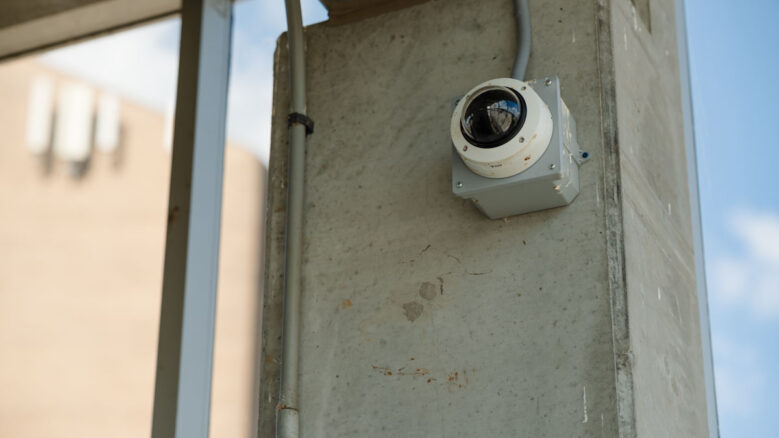
Lockhart said the blowback to the program surprised him because the cameras already existed across Lawrence. Lawrence has about 500 city cameras, police said Wednesday, and have had traffic and public safety cameras throughout town since 2008. Plus, many businesses and homes already have cameras installed — they just aren’t yet registered or integrated with the police.
“When I came here four years ago, I was shocked at how many cameras we had,” Lockhart said. “Because you would think in a city like Lawrence, they wouldn’t want cameras, but they’ve approved them every time that they’ve been implemented.”
Lockhart said the police have used cameras to solve many cases, including a hit-and-run that killed 20-year-old Elsa McGrain, a premed student at KU, last year. He said the police look at cameras only after an incident has happened.
If local news matters to you, please help us keep doing this work.
Don’t miss a beat — get the latest news from the Times delivered to your inbox:
Click here to learn more about our newsletters first

Cuyler Dunn (he/him), staff reporter, has worked with The Lawrence Times since April 2022. He can be reached at [email protected].
Read his complete bio at this link. Read more of his work for the Times at this link.

Jacob Rice (he/him), photo correspondent, has worked with The Lawrence Times since March 2026. He studied journalism and mass communications at Iowa State University, where he spent four years as the visuals editor for the Iowa State Daily.
Check out his photography for the Times here. Read his articles for the Times at this link.
More coverage: Lawrence Police Department
 Jacob Rice / Lawrence Times
Lawrence police aim to assuage privacy concerns about camera integration program
 Nathan Kramer / Lawrence Times
 Nathan Kramer / Lawrence Times
 Contributed photo
 via Sanctuary Alliance

Latest Lawrence news:
 Jacob Rice / Lawrence Times

 Jacob Rice / Lawrence Times
 Logan Pierson / Lawrence Times