
Statewide balloting tests impact of prominent partisan endorsements
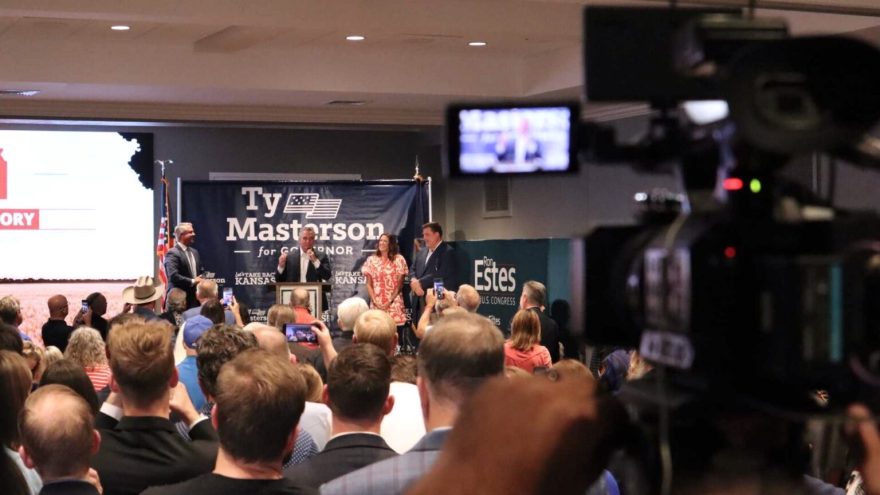
TOPEKA — Republican Ty Masterson rode President Donald Trump’s endorsement to victory Tuesday in a volatile and expensive seven-candidate gubernatorial primary, while Democrat Cindy Holscher shrugged off Gov. Laura Kelly’s blessing of a rival candidate to win the party’s nomination.
Masterson, the Andover president of the Kansas Senate, built an early lead with 42% of the GOP vote as results began rolling in from precincts statewide. He ran away from businessman Phil Sarnecki and Kansas Insurance Commissioner Vicki Schmidt and Secretary of State Scott Schwab. Sarnecki had no previous political experience, Schmidt was vulnerable to attacks for a series of moderate votes on abortion as a member of the Legislature and Schwab never found his footing in a crowded field of conservatives. With incomplete, unofficial results, Sarnecki was at 22%, Schmidt at 14% and Schwab at 11%.
“Tonight belongs to the people of this great state,” Masterson said. “Kansans said loud and clear: We want lower taxes, safe communities, educational freedom and an economy that creates opportunity for every family.”
Masterson tipped his hat to Trump for “friendship and his support throughout this campaign,” invited Republicans who voted for other candidates to “join us” and pledged to be “the governor of every Kansan.”
The roster of other Republicans in the race included former Johnson County Commissioner Charlotte O’Hara of Olathe, Nick Reinecker of Inman and Wichita businessperson Stacy Rogers. The large field, diminished slightly by departure of former Gov. Jeff Colyer, consumed millions of dollars in a quest to find the winner.

Democratic ledger
In terms of Democratic voters taking part in selecting a gubernatorial nominee, they made it possible for Holscher and Corson — both state senators from Johnson County — to fulfill expectations for a close race once the polls closed. As the evening wore on, the outcome became clear. Holscher was able to broaden her advantage to 48% as Corson slipped to 39%. The third option, Overland Park Mayor Curt Skoog, earned 13% of the vote.
While Corson secured the outgoing Democratic governor’s endorsement and spent heavily on television ads, he struggled to connect with voters concerned about his electability in November. There was a sense among some Democrats that Holscher’s mix of public policy positions and a combative campaign style were better suited for challenging the GOP nominee.
Holscher, of Overland Park, offered herself as an anti-establishment candidate dedicated to funding K-12 public education, protecting communities from the data center craze, legalizing cannabis and restraining use of tax breaks to drive economic growth.
“I’m not attached to the establishment. I’m attached to working people,” Holscher said. “I’ll take on anyone, regardless of party, who stands in the way of lower costs, better schools and a government that works for everyday people. I won’t be bought by billionaires, bullied by special interests and insiders, or pressured by the political establishment.”
Corson, an attorney who worked at the U.S. Department of Commerce before entering the state Senate, said he was the only Democrat with a strategy for responsibly lowering property taxes. He promised that as governor he would veto “pork” projects thrown into the state budget by the Legislature and reject bills designed to undermine abortion rights affirmed in a statewide vote in 2022.
History as a guide
Kansans have a tradition of cycling between Republican and Democratic governors. Kelly, the two-term Democrat, followed Colyer, who finished the unexpired second term of GOP Gov. Sam Brownback. Brownback won the governorship after departure of Democratic Gov. Mark Parkinson, who completed the last year of Democratic Gov. Kathleen Sebelius’ second term.
In 2022, Kelly dominated a two-candidate primary with 93% of the vote. She went up against then-Attorney General Derek Schmidt, who had won the GOP nomination with 80% of the party’s vote. In the general election, Kelly won a second term by outrunning Schmidt by a margin of 49.5% to 47.3%.
Kelly prevailed in 2018 by winning a five-candidate primary in which she scored 51.4% of the vote. Her top competition came from former Wichita Mayor Carl Brewer with 20.1% and Josh Svaty at 17.4%. Then-Secretary of State Kris Kobach won the GOP primary against Colyer by 343 votes out of more than 250,000 cast. In the general election, Kelly secured 48% of the vote to Kobach’s 42.9%.
Kansas Reflector is part of States Newsroom, a network of news bureaus supported by grants and a coalition of donors as a 501c(3) public charity. Kansas Reflector maintains editorial independence. Contact Editor Sherman Smith for questions: [email protected]. Follow Kansas Reflector on Facebook and Twitter.
Don’t miss a beat — get the latest news from the Times delivered to your inbox:
Click here to learn more about our newsletters first
More coverage: Election 2026
 Cuyler Dunn/Lawrence Times