

Two local poets and scholars wrote a zine based on a simple premise: What if Douglas County was “Douglass” County?
With support from Babbling Bookery, A.D. Boynton II and Mercedes Lucero will launch their zine, “American Reclamation,” on Friday, July 3 at the Raven Book Store.
Boynton and Lucero, members of the Black Literature & Arts Collective of Kansas, are expanding on an idea from Kevin Willmott.
Willmott is an Oscar-winning filmmaker and professor emeritus at the University of Kansas. He went before the county commission on Feb. 4 to suggest adding a single “s” to the county’s name.
Douglas County is currently named for Stephen A. Douglas, a United States Senator from Illinois famous for the Lincoln-Douglas debates. Willmott told the commission that Douglas was not an abolitionist, but a white supremacist.
Don’t miss a beat … Click here to sign up for our email newsletters
Click here to learn more about our newsletters first
“I have an idea how we could link Lawrence in a better way to the Free State tradition,” Willmott said in February. “There’s another Douglass, another very famous man named Douglass. His name is Frederick Douglass. He was an abolitionist.”
Douglass, Willmott went on to say, was the first Black person to speak with Lincoln in the White House.
Please support
The Lawrence Times!
Subscribe here.
“What might it mean for us to rename the county for someone who is actually much more connected to some of the values that Lawrence historically stands for, especially in terms of abolition?” Boynton asked on Tuesday.
They said some scholars waffle on Douglas’ exact position on slavery.
Deborah Keating wrote an article devoted to Douglas for the Kansas City Public Library’s digital history project, “Civil War on the Western Border.” Keating has a PhD in history from the University of Missouri-Kansas City.
“Douglas’s position on slavery is one debated by historians,” Keating wrote in the article. “In an oft-quoted comment, Douglas claimed not to care whether slavery ‘was voted up or down, only that the decision be left to local majorities.’”
Keating goes on to describe an encounter where Lincoln pressed Douglas to take a stance on slavery.
“Douglas argued that the question was moot because the Constitution of the United States allowed slavery to exist,” Keating wrote. “He believed that only a state, through the voice of its inhabitants and their elected legislatures, had the right to decide to allow slavery within its borders.”
The “History” section of Douglas County’s administration webpage says the area was named in honor of the Illinois senator because he “took a leading part in securing the adoption of the ‘popular sovereignty’ principle in the Act organizing Kansas Territory, which gave the particular form of the issue involved in the Kansas struggle.”
Douglas presented a bill called the Kansas-Nebraska Act of 1854, which introduced popular sovereignty to what is now called Kansas. Under popular sovereignty, only certain residents of a state could vote on the issue of becoming a free or a slave state. While Kansas ultimately entered the Union as a free state following an infamous 1855 election and the period “Bleeding Kansas,” African-Americans were denied the opportunity to weigh in on their fates.
“And be it further enacted, That every free white male inhabitant above the age of twenty-one years who shall be an actual resident of said Territory, and shall possess the qualifications hereinafter prescribed, shall be entitled to vote at the first election,” the bill reads.
The Kansas-Nebraska Act also repealed the Missouri Compromise, which had banned slavery above the 36º30 parallel. Those territories included present-day Kansas and Nebraska.
Ultimately, Boynton finds the lack of clarity around Douglas’ moral stance questionable.
“That’s weird,” he said. “I want people to know that I was opposed to slavery if they are reading about me 100 years from now.”
An urgency to define our values
“It may sound fanciful, it may sound even radical, but I think that’s also the point,” Boynton said of the proposed name change.
He said Willmott presented the idea for the county name change at a Juneteenth luncheon that took place in February. Boynton and Lucero jumped on the idea and spoke to Willmott to inform the zine, but Willmott was not involved in the publication.
“The thing that Mercedes and I are going for is that change happens through multiple vectors,” they said.
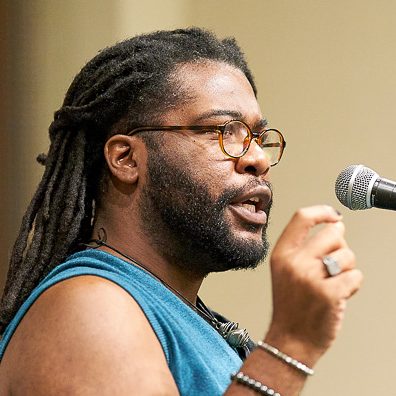
When folks open the first page, they’ll find a poem from Boynton called “An Urgency.”
“The urgency is not necessarily to rush us into changing the name, but I do think that it clarifies why it might be important to think about a name change,” he said.
“American Reclamation” also has background on Douglas and Douglass, and each copy folds open into one of six poster designs created by Lucero and the folks at Babbling Bookery.
The team behind the zine chose to host the launch event and open mic night the day before July 4, which will be the epitome of America 250 celebrations. Boynton said they picked that date because it is a fraught moment in American history as we define our story.
“Do we want to live somewhere that allows us universal healthcare? Do we want to live somewhere that’s bombing children?” Boynton asked. “Do we want to live somewhere that believes in education, that believes in righteousness and equity? So, some of the reclaiming that I think has to happen is around what we really believe in about our society and our citizenship.”
Boynton anticipates pushback as the name change movement picks up steam, similar to the national debates that took place a few years ago around taking down Confederate statues.
However, he said, Douglas County wouldn’t be the first place to add the “s.”
Douglass (Anna and Frederick) Park in Chicago was originally named for the senator Douglas. In 2020, a Chicago park board voted to rename the historic venue to honor the abolitionist couple.
“It definitely deserves discussion, but if we’re standing in this in terms of like, ‘Oh, it’s impossible, it’s so hard,’ that’s actually not really productive, and that’s telling in another way,” he said.
Boynton said they’re excited to see how Willmott pushes the proposal forward with the county commission and other parties.
The zine launch event and open mic will start at 6:30 p.m. on Friday, July 3 at the Raven Book Store, 809 Massachusetts St. It is open to the public.
Anyone can sign up for the open mic between 6:30 and 7 p.m. Boynton expects that many of the readings will have a political charge given the timing, but they said that’s not required to participate.
Learn more about the event at this link.
Folks can get the zine for free at the launch, or purchase it for $5 afterward. Boynton said they’re still sorting out distributors, but there will likely be copies available at the Raven and Wonder Fair.
If local news matters to you, please help us keep doing this work.
Don’t miss a beat — get the latest news from the Times delivered to your inbox:
Click here to learn more about our newsletters first

Wulfe Wulfemeyer (they/them), reporter and news editor, has worked with The Lawrence Times since May 2025. They can be reached at [email protected].
Read their complete bio here. Read their work for the Times here.
Latest Lawrence news:

 Cuyler Dunn/Lawrence Times
 Nathan Kramer / Lawrence Times