
The prothonotary warbler population in Kansas is growing as the birds stop to breed before heading south. Researchers are using electronic trackers to study their movements.
Kathy Fox and her husband live outside of Pittsburg, Kansas, near the Mined Land Wildlife Area. After her husband had a stroke, they had to slow down and started focusing more on the birds and nature around their home.
A few years later in 2023, she noticed bright yellow birds — about the size of your hand — in her bluebird boxes. Those birds were prothonotary warblers. She didn’t realize the songbirds nested in southeast Kansas.
“I just thought it was migrating through. It was really exciting. They’re just beautiful birds and they eat a lot of insects,” Fox said.
What she noticed was part of a change for the colorful birds. They’re predominantly a forest species, which is why they generally stop in more tropical areas. Deforestation has caused the birds to stop and breed more in wooded areas of Kansas that used to be strip mines.
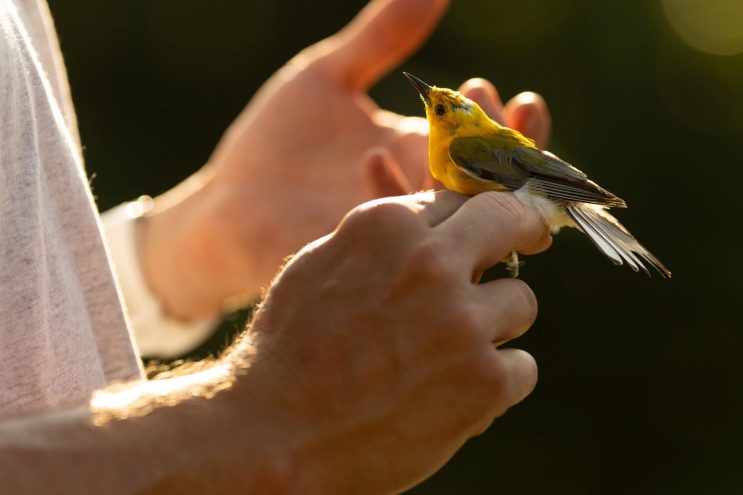
The small, palm-sized songbirds being in southeast Kansas inspired Gabe McClain, a Pittsburg State University biology graduate student. He’s been studying their migration habits using tiny geolocators, or trackers.
The trackers are about the width of your finger. They’re placed on the bird’s back. It has flexible strings tied to it and the bird wears it like a backpack.
Don’t miss a beat … Click here to sign up for our email newsletters
Click here to learn more about our newsletters first
The trackers are only put on male birds, because female birds are smaller. The weight of the tracker would affect their flying abilities. McClain said they can only tag a bird with an object that’s 3% or less of its body weight.
The tracker collects data every five minutes. The data isn’t accessible until the birds come back to Kansas and the tracker is taken off of the bird.

The species breeds in Kansas before migrating to Columbia in South America.
“This is the farthest west that they will breed. They’ve been seen as far west as Wichita, but that’s about where things end,” McClain said.
McClain said the species are doing well in the eastern part of the state, better than in many other parts of its range.
“Several years ago, you might not have expected to see them here,” he said.
A map tracking one of the warblers shows its entire 5,000 mile journey starting in late April in Honduras and ending in early May in northeast Kansas.
The birds have been studied by McClain, his advisor Andrew George and many volunteers. They catch the birds in small ‘nest boxes’ resembling actual nests. There are more than 200 nest boxes in 12 locations in both north and southeast Kansas. There are also some in southwest Missouri.
“The reason we catch them is to take a little bit of data on body size, body condition,” he said.
After catching, the birds get the backpack geolocator and bands on their legs that correspond with the site of their capture.
“So you have one loop on each side forming that figure 8 with the transmitter in the middle,” McClain said. “And essentially that transmitter is going to sit on the back of that bird and the loops are going to pass through both of their legs. “
This year there were 36 trackers on birds, a big increase from last year’s six.
McClain said this research project was a team effort. His research was funded by private donors and supported by the two Audubon societies in Kansas City and southeast Kansas.
“It truly was those people being invested in this species and valuing what’s going to happen to it that made this project successful,” he said.

One bird, nicknamed Hydrogen, successfully carried his tracker throughout his entire 5,000 mile migration journey.
His journey impressed Ann Tanner, who was a volunteer for the project through the Burroughs Audubon society.
“He carried a geolocator to Colombia and came back and we put another geolocator on them,” Tanner said. “We expect them back next year.”
Tanner is originally from Mississippi, another place where a researcher was studying the warblers in the same way that McClain and his team are.
She remembers seeing a warbler as a young girl. She asked her dad what she called a “beautiful yellow bird” was. Her dad said it was a canary, but it was actually a prothonotary warbler.
She calls the birds “amazingly dedicated parents.” Tanner said the warblers risk their lives to save and defend their nests and tend to their babies.
“And once they lay their eggs, they are totally dedicated,” she said. “The mom sits on the nest day after day in the heat of the summer.”
McClain hopes this research will help him understand how much their population is thriving with their migration and breeding habits in Southeast Kansas.

Rachel Schnelle reports on Missouri and Kansas issues for KRPS.
The Kansas News Service is a collaboration of KCUR, Kansas Public Radio, KMUW and High Plains Public Radio.
Kansas News Service stories and photos may be republished by news media at no cost with proper attribution and a link to ksnewsservice.org.
Don’t miss a beat — get the latest news from the Times delivered to your inbox:
Click here to learn more about our newsletters first