
Researchers at the University of Kansas and their collaborators landed a $1.9 million grant to research drought tolerance in wheat and rice.
They’ll use fungal samples from the International Collection of Vesicular Arbuscular Mycorrhizal Fungi, or INVAM, a fungi library housed at the Kansas Biological Survey.
The grant from the National Science Foundation will fund a four-year study led by Arkansas State University, with researchers from KU, Kansas State University and the University of Nebraska.
“With the human population projected to grow for the next 50 to 60 years and the amount of arable land shrinking, building drought tolerance is a major strategy for increasing food production,” according to a KU news release. “(Drought tolerance) would reduce the need for irrigation and help protect water supplies.”
Don’t miss a beat … Click here to sign up for our email newsletters
Click here to learn more about our newsletters first
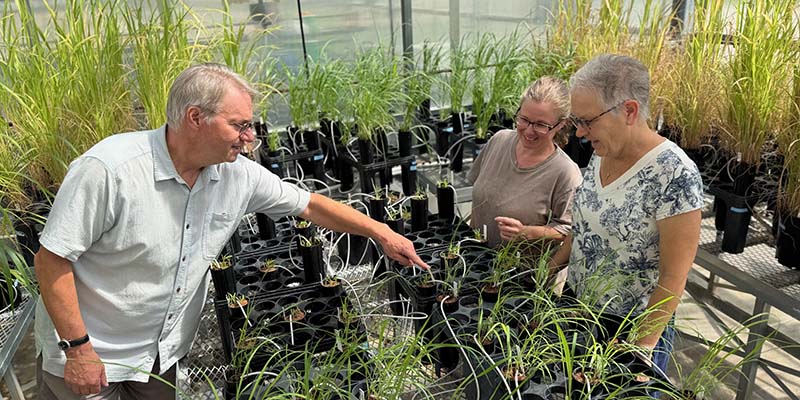
The project will look at arbuscular mycorrhizal fungi, or microscopic AM fungi, to see if different strains help wheat and rice tolerate drought. INVAM will supply all of the samples for the project.
“Soil microbes can have a big influence on crop resilience to drought, and this project will test benefits of an important group of soil fungi that associate with plant roots,” said Jim Bever, the lead researcher at KU and a professor, in a news release.
Bever’s research team at KU had previously raised alarm about INVAM’s funding as they rely on NSF grants that looked iffy as President Donald Trump sought to slash the agency’s budget.
KU researchers will also test drought responses in Kernza, a perennial grain, and interview farmers involved in wheat and rice agricultural production in Kansas, Nebraska and Arkansas.
“By talking to farmers and others involved in these agricultural systems we can learn — beyond genetics and technical solutions — what needs to change in our agricultural systems that relates to banking systems, adaptation to regional ecology and the continued evolution of technology,” said Paul Stock, a KU associate professor of sociology and environmental studies.
Additionally, the grant will support training for scientists and socio-economists, plus educational outreach.
If local news matters to you, please help us keep doing this work.
Don’t miss a beat — get the latest news from the Times delivered to your inbox:
Click here to learn more about our newsletters first

This post is by the Lawrence Times news team.
If you have news tips, questions, comments, concerns, compliments or corrections for our team, please reach out and let us know what’s on your mind. Email us at [email protected] (don’t forget the KS!), or find more contact info and a quick contact form at LawrenceKSTimes.com/contact.
Follow us so you won’t miss the local news that matters most to you:
Latest Lawrence news:
 Molly Adams / Lawrence Times
 Molly Adams/Lawrence Times
 August Rudisell/Lawrence Times